Highlights
- What is the saudi non oil economy ?
- saudi non oil economy Impact on Real Estate
- Urban Growth and Real Estate Transformation
- Frequently Asked Questions
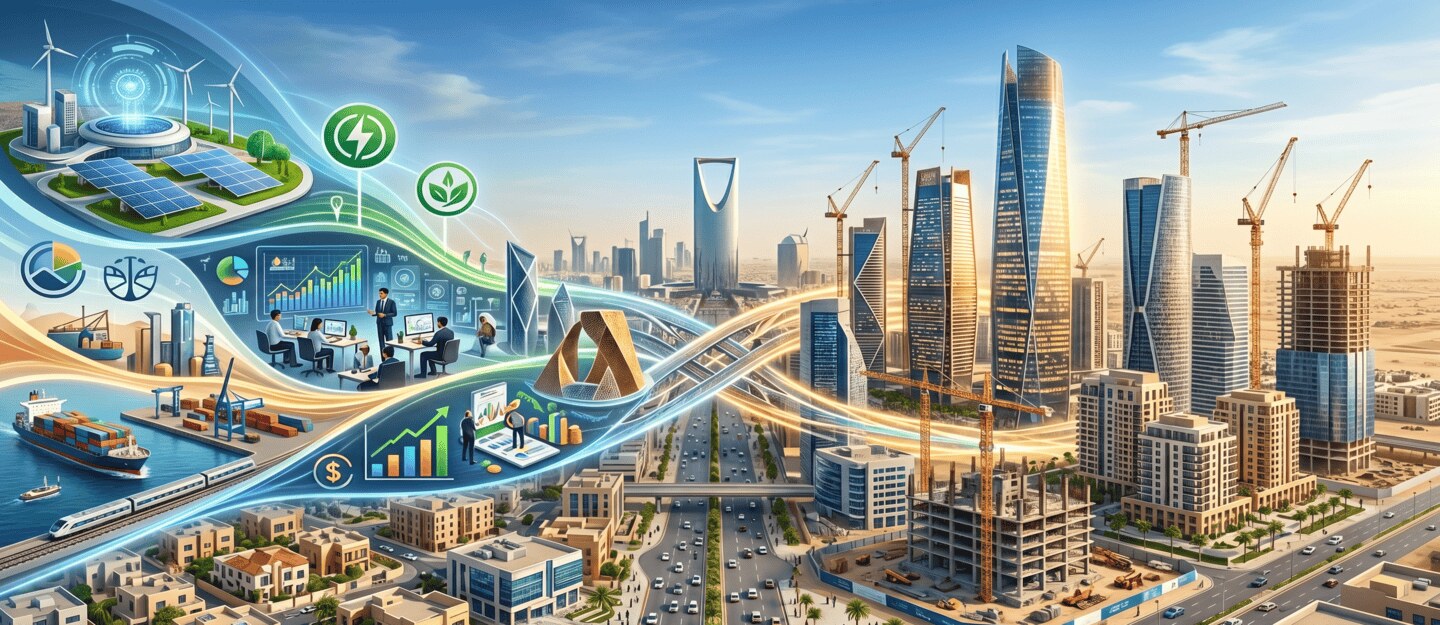
What is the relationship between the real estate sector and the saudi non oil economy ? Saudi Arabia is undergoing a major economic transformation focused on reducing oil dependency. It now plays a key role in shaping investment, infrastructure, and real estate demand across the Kingdom.
Read on to learn how this shift is redefining the future of property investment in Saudi Arabia and creating new opportunities across residential, commercial, and hospitality sectors.
What is the saudi non oil economy ?
The Saudi non oil economy refers to all economic activities that do not depend directly on crude oil production and exports. It is a key pillar of Saudi Vision 2030, which aims to build a more diversified, sustainable, and resilient national economy.
non oil activities
Non-oil activities include sectors such as:
- Construction and real estate development
- Financial and insurance services
- Wholesale and retail trade
- Tourism and hospitality
- Manufacturing and logistics
- Technology and business services
According to the General Authority for Statistics (GASTAT), non-oil activities grew by 4.6% in Q2 2025, contributing significantly to overall GDP growth and becoming the main driver of economic expansion.
Also Read: Saudi Real Estate Price Index Decrease By 0.7%
non oil based economy
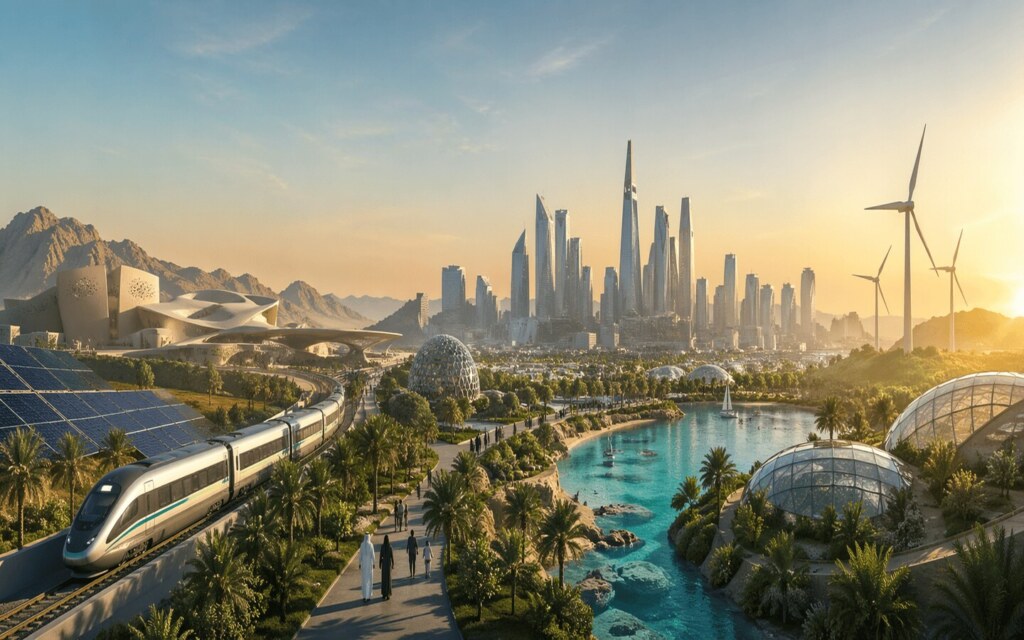
A non-oil based economy is one where growth is not primarily dependent on hydrocarbons but is instead supported by multiple productive sectors.
In Saudi Arabia:

- Non-oil activities accounted for 54.8% of GDP in 2024 (Saudi Ministry of Economy and Planning)
- The sector continues to expand through investment, privatization, and giga-project development
- It reduces exposure to global oil price volatility and strengthens long-term economic stability
How Does the Saudi Non Oil Economy Impact Real Estate in Saudi Arabia?
The transformation of the saudi non oil economy has a direct and powerful impact on the real estate sector. As economic activity diversifies, demand for housing, offices, hotels, and mixed-use developments continues to grow.
Key impact areas
The table below highlights the main real estate segments and how each is being influenced by the expansion of the Saudi non-oil economy:
Sector | Impact on Real Estate |
|---|---|
Sector Residential | Impact on Real Estate Rising demand due to population growth and urban expansion |
Sector Commercial | Impact on Real Estate Increased need for modern office spaces driven by financial and corporate sector growth |
Sector Hospitality | Impact on Real Estate Expansion of tourism driving hotel and serviced apartment demand |
Sector Industrial & Logistics | Impact on Real Estate Growth in trade and manufacturing boosting warehouse and logistics hubs |
Sector Mixed-use developments | Impact on Real Estate Integration of living, working, and leisure spaces in new urban projects |
Also read: Investing in Energy Infrastructure in Saudi Arabia
Supporting economic drivers
The following indicators show the strong growth of Saudi non-oil sectors and their impact on real estate demand:
- Real GDP grew by 3.9% in Q2 2025 (GASTAT)
- Electricity, gas, and water activities grew by 10.3%, boosting infrastructure demand
- Financial and insurance services grew by 7.0%, increasing demand for premium office space
- Trade, restaurants, and hotels grew by 6.6%, supporting hospitality real estate
Real estate as a core engine of diversification
Real estate is no longer a secondary outcome of economic reform. It has become a central driver of the Saudi non oil economy.
Key developments include:
- Over $1.3 trillion in real estate and infrastructure projects since 2016
- Plans to deliver 1 million+ homes, 7.9 million sqm of office space, and 358,000 hotel rooms
- Foreign ownership reforms opening Saudi property markets to international investors
Why the Non-Oil Economy Matters for Investors
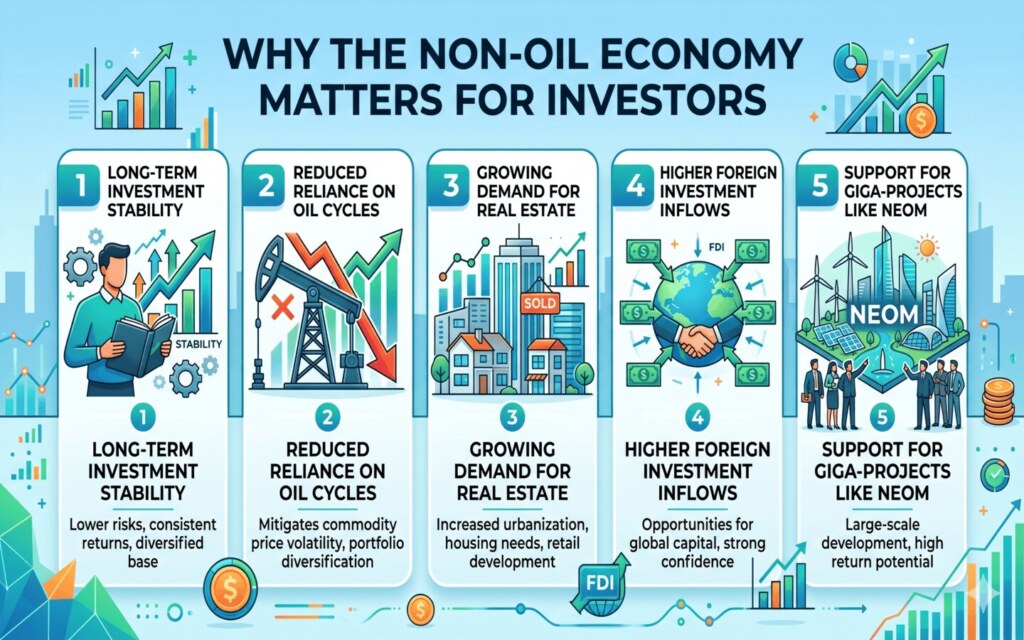
The expansion of the Saudi non oil economy creates long-term investment stability by:
- Reducing reliance on oil cycles
- Increasing predictable demand for housing and commercial assets
- Encouraging foreign direct investment
- Supporting mega projects like NEOM and other giga developments
Urban Growth and Real Estate Transformation
Saudi cities are evolving into global investment hubs. The rise of non-oil sectors is reshaping urban planning through:

- Smart city development
- Mixed-use communities
- Sustainable infrastructure projects
- Expansion of public services and lifestyle destinations
Between 2018 and 2024, non-oil non-government economic activity increased by 42%, showing how rapidly the transformation is accelerating.
Future Outlook
The future of the saudi non oil economy suggests:
- Continued expansion of tourism and hospitality
- Growth in financial services and international corporate presence
- Strong demand for premium residential and commercial assets
- Increased reliance on construction and real estate as economic engines
Government Policies and Regulatory Reforms Driving Real Estate Growth
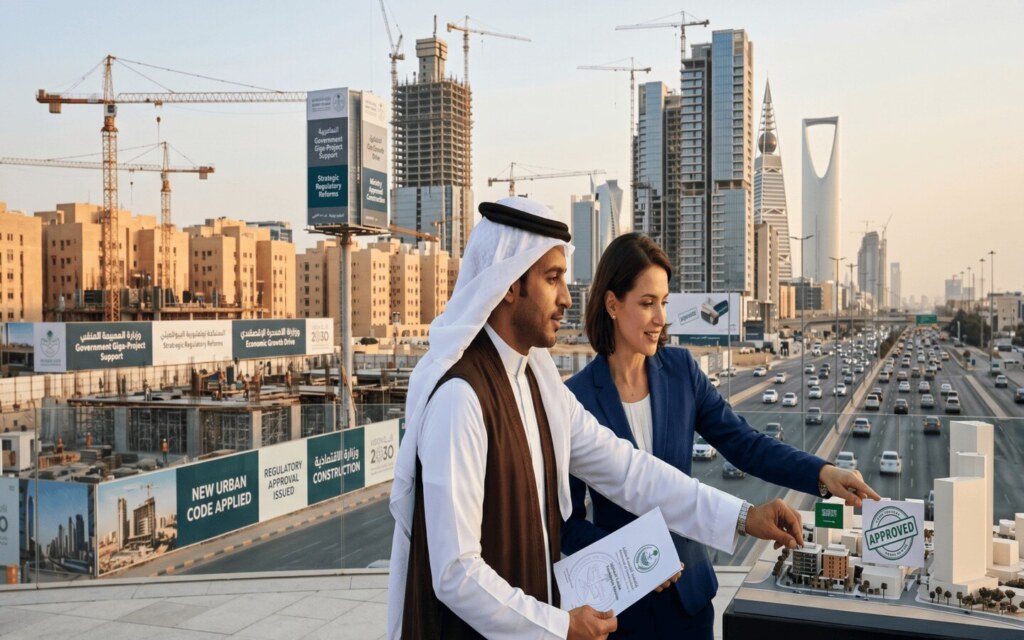
The transformation of the Saudi non oil economy is being strongly supported by a set of strategic government policies and regulatory reforms that directly shape the real estate sector and its long-term growth.
Vision 2030 as the Main Driver of Transformation
One of the most influential factors strengthening the link between the Saudi non oil economy and real estate is the national transformation agenda under Saudi Vision 2030. This framework is resha
ping economic priorities by reducing oil dependency and positioning real estate as a core growth sector within a diversified economy.
Institutional Support and Regulatory Development
Key institutions such as Saudi Ministry of Investment and Ministry of Municipal and Rural Affairs and Housing play a central role in improving market efficiency. Their reforms focus on simplifying ownership regulations, enhancing urban planning systems, and encouraging private sector participation in real estate development.
Housing Programs and Market Expansion
Initiatives like Sakani Program are significantly boosting residential supply and supporting homeownership. These programs are helping to balance supply and demand in the housing market while stimulating construction activity and increasing accessibility for Saudi citizens.
Impact on Market Confidence and Investment Flow
According to data from General Authority for Statistics, ongoing reforms have strengthened investor confidence and accelerated growth in both residential and commercial property sectors. The improved regulatory environment is also attracting more local and international investment into real estate projects.
Overview of Key Policy Impacts on Real Estate
The following table highlights the most important government policies and initiatives and their direct impact on the real estate sector in Saudi Arabia:
Policy / Initiative | Key Objective | Impact on Real Estate |
|---|---|---|
Policy / Initiative Vision 2030 Programs | Key Objective Economic diversification | Impact on Real Estate Increased demand across all property sectors |
Policy / Initiative Foreign Ownership Reforms | Key Objective Attract global investors | Impact on Real Estate Higher liquidity and international participation |
Policy / Initiative Sakani Housing Program | Key Objective Boost homeownership | Impact on Real Estate Growth in residential developments |
Policy / Initiative Privatization Initiatives | Key Objective Expand private sector role | Impact on Real Estate New real estate investment opportunities |
Policy / Initiative Tourism Development Policies | Key Objective Support non-oil sectors | Impact on Real Estate Increased demand for hospitality assets |
Frequently Asked Questions (FAQ)
The following are the most common questions about the Saudi non-oil economy and its impact:
Non-oil activities accounted for approximately 54.8% of GDP in 2024, reflecting strong diversification progress.
Saudi Arabia is actively preparing for a post-oil future by developing non-oil sectors such as tourism, real estate, technology, and manufacturing under Vision 2030.
Oil remains a major revenue source, funding national development, infrastructure, and public services. However, its relative importance is gradually decreasing due to diversification.
Yes. Saudi Arabia has significantly expanded non-oil exports, particularly in petrochemicals, manufacturing, and services, as part of its economic diversification strategy.
By the end of our article, we have explored the saudi non oil economy and its relationship with the real estate sector, as well as how Vision 2030 is reshaping the property market in the Kingdom. We invite you to visit Bayut Blog to discover everything related to real estate in Saudi Arabia.


 as a preferred source on Google