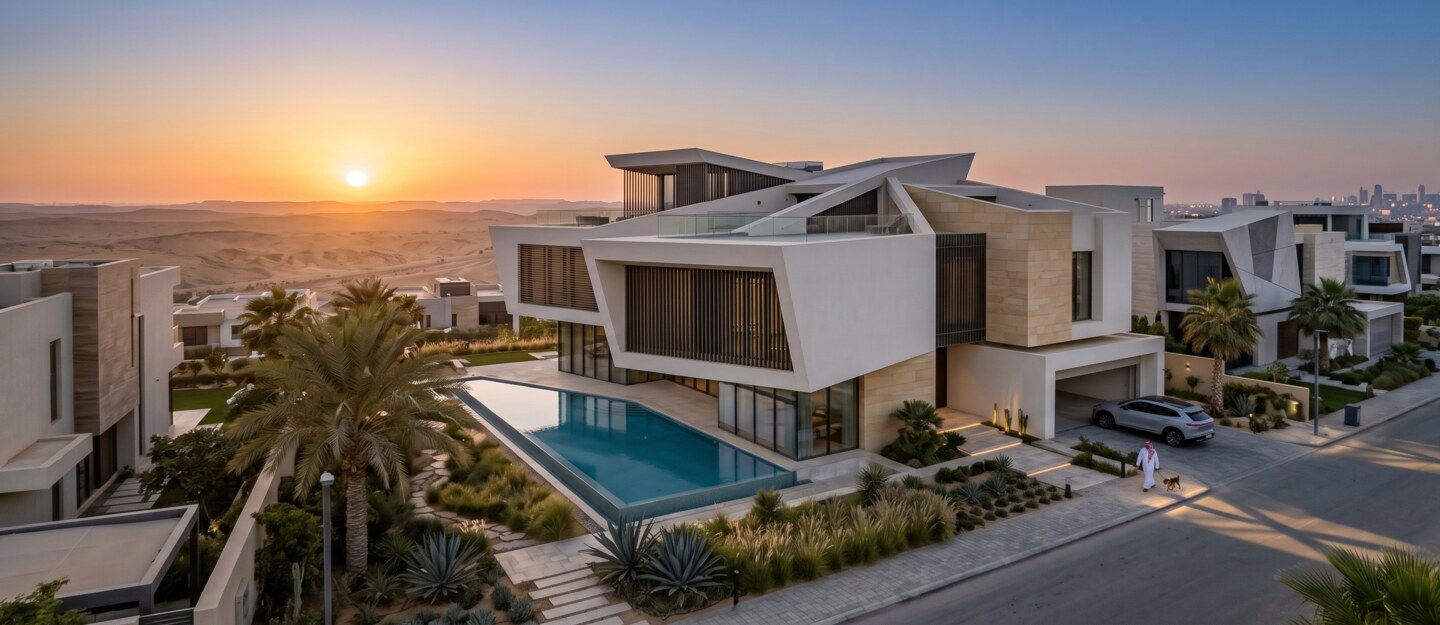
Villa market in Saudi Arabia right now means documenting a landscape undergoing a massive, rapid transformation. Driven by Vision 2030, a young demographic, and shifting lifestyle preferences, the Saudi residential sector has evolved far beyond basic housing.
The Architectural Shift of Villas in Saudi Arabia
Historically, Saudi villas were often designed as highly insulated fortresses prioritizing maximum privacy, with high boundary walls and smaller windows. Today, there is a major architectural evolution happening.
Additionally, there are different prominent architectural designs, including the following:
Salmani Architecture
This design philosophy, championed in the capital, blends traditional Saudi heritage (like Najdi architectural motifs) with modern and clean lines. Moreover, multiple residential projects have embraced this design.
Open but Private
Modern buyers want natural light and open floor plans. Architects are achieving this by using internal courtyards, smart shading and directional window placement that allows for massive glass facades without compromising family privacy.
Flexible Spaces
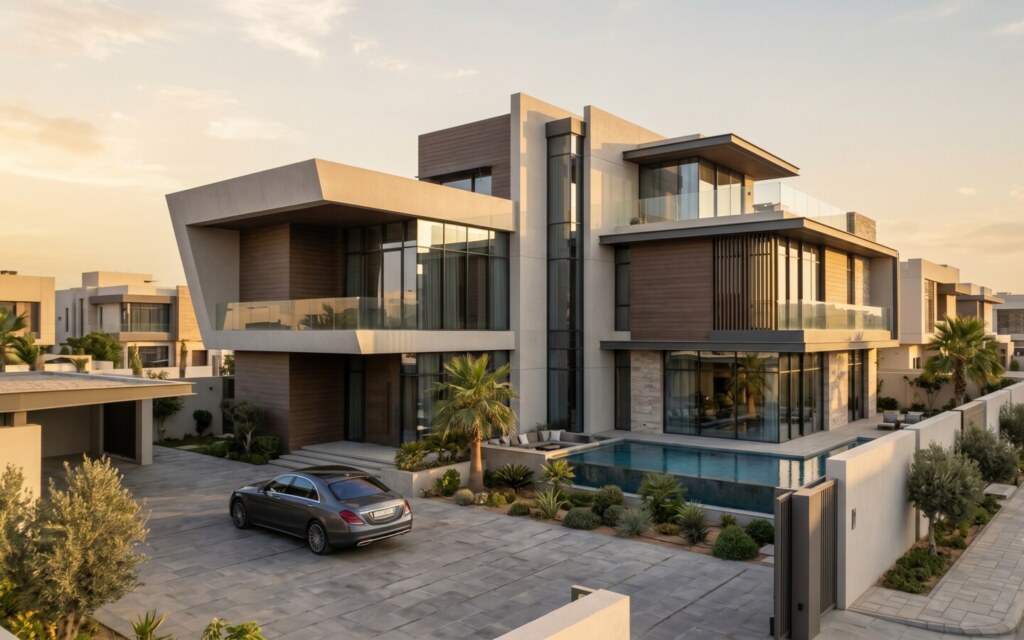
Families want spaces that can easily transition from a formal “majlis” (reception area) to a casual family room or a remote workspace. This embodies the perfect choice for anyone who thinks about his dream house, delivering all the requirements and demands.
The Integrated Communities of Villas in Saudi Arabia
Perhaps the biggest in the Saudi real estate market is where these villas are being built. Instead of buying an isolated piece of land and building a standalone home, buyers can flocking to master planned communities developed by giants like:
- ROSHN
- National Housing Company (NHC)
- Dar Al Arkan
These new villa developments are pitched as complete ecosystems. They feature pedestrian-friendly streets, central parks, retail centers, mosques, and sports facilities right outside the front door, fundamentally changing Saudi neighborhood dynamics.

Smart Homes as the Baseline
For the luxury and upper-mid-tier villa market, smart home technology is no longer an “upgrade”—it is the baseline expectation. High-end villas now feature deeply integrated climate control, automated shading, and advanced security protocols built directly into the home’s infrastructure during construction.
Beyond individual homes, new villa communities are integrating AI-assisted property management that optimizes energy use and streamlines community security.
Villa Prices in Saudi Arabia
Villa prices in Saudi Arabia have seen sustained growth throughout 2025 and 2026, driven by high demand and rising construction standards. Here is a summary of the prices in the major cities:
Villa Prices in Riyadh
The capital’s market is highly segmented by geography. According to Bayut’s search trends, the average cost for villas for sale in North Riyadh (which includes highly sought-after neighborhoods like Al Narjis and Al Yasmeen) sits at roughly SAR 3.98 million.
Meanwhile, villas in West Riyadh present a more accessible entry point, with average asking prices around SAR 2.28 million. For buyers looking for budget-friendly options, smaller family homes and duplexes in South and East Riyadh can be found starting between SAR 980,000 and SAR 1.45 million.
If you are more interested, you can also check out VION Villas in Riyadh.
Villa Prices in Jeddah
The coastal city offers a varied range of properties, from beachfront luxury to affordable suburban plans. Bayut’s current market overview shows that the average asking price for a 3-bedroom villa in Jeddah is approximately SAR 1.99 million.

Larger properties remain competitively priced, with 4-bedroom and 5-bedroom villas averaging SAR 1.81 million and SAR 1.83 million, respectively.
Demand in the Villa Market in Saudi Arabia
The for residential real estate, specifically villas and townhouses, is robust and accelerating. The Saudi real estate market size is projected to grow from $72.8 billion in 2026 to nearly $103 billion by 2031. Several key factors are driving this intense demand:
Household Formation
Saudi Arabia’s population is growing rapidly, and average household sizes are shrinking as young professionals move out earlier. This demographic shift is creating an annual demand for approximately 115,000 new homes across the Kingdom.
Vision 2030 and Homeownership
The government’s push to reach a 70% citizen homeownership rate by 2030 is heavily subsidizing demand. Programs like “Sakani” provide vital mortgage support, making villas more accessible to middle-income families.
Giga Projects & Corporate Relocations
Massive infrastructure spending and the Regional Headquarters program in Riyadh are bringing an influx of both Saudi nationals and expatriates into the major cities, driving demand for high-quality, community-integrated villas.
Also you can read about Vision 2030 Mega Projects Update.
Supply Gap
Despite massive pipelines from state-backed developers—who are slated to deliver tens of thousands of units across 2026 and 2027—demand still outpaces actual delivery in prime areas, keeping the market highly competitive.
Requirements for Buying a Villa in Saudi Arabia
The legal framework for purchasing a villa depends on the buyer’s nationality, but recent 2026 regulatory updates have streamlined the process significantly.
Requirements for Saudi Citizens
The process is straightforward. Citizens secure financing—often facilitated through government-backed mortgage programs like Sakani if they are first-time buyers—and complete the transfer of the title deed electronically through the Ministry of Justice’s Najiz portal or the Real Estate Registry branches.
Requirements for Foreigners & Expatriates
As of early 2026, Saudi Arabia introduced a unified, centralized digital regime that makes it much easier for non-Saudis to purchase property.
Designated Zones
Foreigners can now buy real estate (including villas) outright, provided the property is located within specific geographic zones approved by the government.
Centralized Digital Process
The entire transaction is conducted through a single digital portal administered by the Real Estate General Authority (REGA).
Resident vs. Non-Resident
Expatriates living in the Kingdom simply need a valid residency permit (Iqama) to log into the portal, select a property in an approved zone, and pay the government fees.
Non-residents can also buy; they must first verify their identity through a Saudi diplomatic mission and obtain a “Digital Identity” to access the portal.
Ultimately, for more details about the villas market in Saudi Arabia , you can check all the interesting information in Bayut Blog, which is the largest real estate portal that you can meet all of your demands and needs in.


 as a preferred source on Google