
Investing in Saudi real estate requires quick, informed decisions. The 7% Rule in Real Estate is a simple yet powerful tool that helps investors quickly evaluate whether a rental property may deliver strong returns.With Saudi Arabia’s real estate evolving under Vision 2030, this rule gives investors an edge.
Continue reading to learn about the meaning of the rule, how it works, its limitations, and how it applies to the Saudi real estate market.
What is The 7% Rule in Real Estate ?
The 7% Rule in Real Estate is a general guideline used by investors to quickly assess the income potential of a rental property. According to this rule, a property is considered potentially attractive if its gross annual rental income equals at least 7% of its purchase price.
This rule is designed as a first screening tool, not a final investment decision metric. It helps investors eliminate weak opportunities early and focus on properties that may deliver reasonable returns.
How the 7% Rule Works
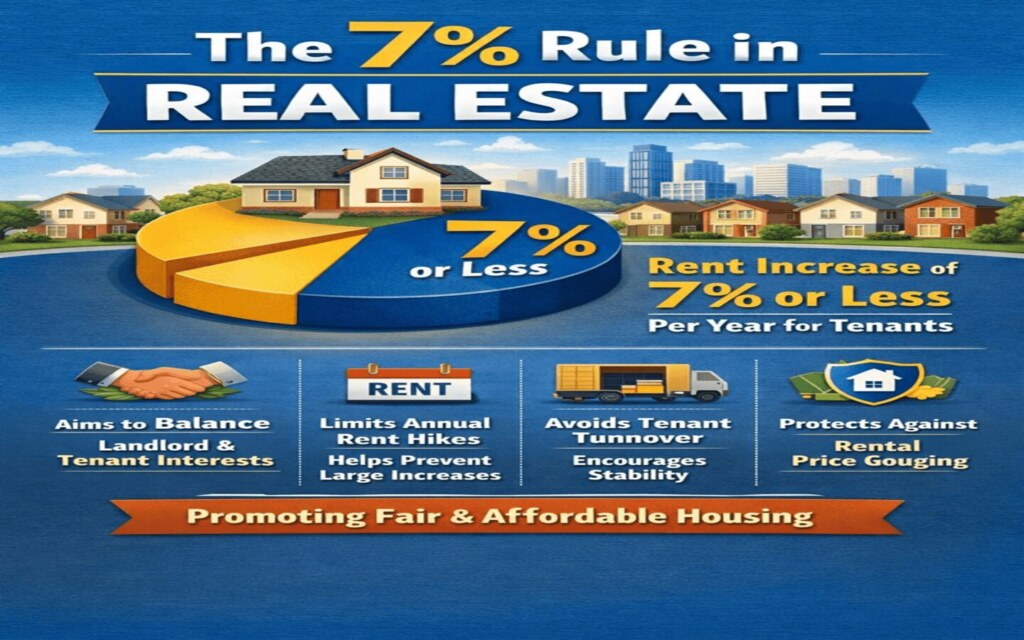
Before diving into calculations, it’s important to understand the basic principle behind the 7% Rule and how it helps investors quickly screen rental properties.
Item | Explanation |
|---|---|
Item Purchase Price | Explanation Total cost of acquiring the property |
Item Target Annual Rent | Explanation Purchase Price × 7% |
Item Monthly Rent Target | Explanation Annual Rent ÷ 12 |
Item Decision Indicator | Explanation If market rent meets or exceeds this level, the property may be worth further analysis |
Example:
- Purchase Price: SAR 1,000,000
- Target Annual Rent: SAR 70,000
- Target Monthly Rent: SAR 5,833
Why the 7% Rule in Real Estate Matters to Investors
The 7% Rule in Real Estate is widely used because it is:
- Fast and simple – no complex calculations required
- Objective – reduces emotional decision-making
- Time-saving – filters out low-yield properties early
However, it does not replace full financial analysis, especially in markets with varying demand, regulations, and financing structures such as Saudi Arabia.

The 7% Stop Loss Rule
The 7% Stop Loss Rule originates from investment risk management rather than real estate income analysis. It suggests exiting an investment if its value declines by approximately 7% from the purchase price, in order to limit losses.
In real estate, this concept is applied more cautiously due to lower liquidity. Saudi investors may use it as a strategic reference, especially when investing through real estate funds, REITs, or development projects, rather than direct property ownership.
The 7% Rule in investing
Beyond real estate, the 7% Rule in investing reflects a broader principle of balancing risk and return. Many investors consider 7% an average long-term return benchmark for diversified investments.
In property investment, this aligns with expectations for:
- Rental yield
- Capital appreciation
- Inflation protection
In Saudi Arabia, returns may vary significantly depending on location, asset type, and regulatory factors.
Applying the 7% Rule in the Saudi Real Estate Market
Saudi Arabia’s real estate sector is transforming rapidly due to Vision 2030, population growth, and urban expansion in cities like Riyadh, Jeddah, and Dammam.

Key considerations:
- Strong demand for residential rentals in major cities
- Government-backed housing and infrastructure projects
- Greater transparency through the Real Estate General Authority (REGA)
- Growing foreign investment after regulatory reforms
- Achieving a full 7% yield may be challenging, but lower yields can be acceptable with long-term capital growth
Foreign Investment and the 7% Rule in Saudi Arabia
Saudi Arabia has approved a new Real Estate Ownership Law for Non-Saudis, expected to take effect in January 2026. The law allows foreign individuals, companies, and investment funds to own property within designated zones, while maintaining restrictions in Makkah and Madinah.
For foreign investors, the 7% Rule in Real Estate becomes an important benchmarking tool when evaluating:
- Rental viability within approved zones
- Long-term investment strategies
- Compliance costs, registration, and transaction taxes
Limitations of the 7% Rule

While useful, the rule has clear limitations:
- Does not include operating expenses
- Ignores vacancy rates and maintenance costs
- Does not reflect financing or tax considerations
- May be unrealistic in premium urban markets
Investors should always follow up with a detailed cash-flow and ROI analysis.
Frequently Asked Questions
Before diving into the details, here are some common questions investors ask about this concept:
The 7% Rule in Real Estate is a screening guideline that can be applied in Saudi Arabia, but results vary by city, asset type, and market demand.
Yes. With the new ownership law, foreign investors can use the rule to evaluate rental opportunities within designated investment zones.
Multiply the property’s purchase price by 7% to get the target annual rent, then divide by 12 for the monthly rent. Compare this to the current market rent to evaluate viability.
No, it only considers gross rental income. A full analysis should include expenses, vacancy rates, and financing costs for accurate ROI calculations.
The property may still be a viable investment if it offers strong long-term appreciation or is in a strategic location, but detailed financial assessment is required.
It can be used as a quick screening tool, but commercial properties often require more detailed financial modeling due to variable income and operational costs.
In conclusion, the 7% Rule in Real Estate is a simple and effective tool to quickly screen rental properties in Saudi Arabia. While it does not replace detailed financial analysis, it helps investors focus on promising opportunities. For more expert insights and guides on the Saudi real estate market, visit the Bayut Blog.




 as a preferred source on Google