
Saudi Arabia is going through visible economic and urban change, and any institutional investor is paying close attention. New infrastructure and large development projects are reshaping major cities and creating long-term opportunities in the real estate sector. Institutional investors manage large pools of capital on behalf of pension holders, policyholders, and clients.
These include sovereign wealth funds, pension funds, insurance companies, and asset managers. As Saudi Arabia diversifies its economy and demand for housing, offices, and logistics space grows, institutional capital is increasingly moving into the Kingdom’s property market.
What is an Institutional Investor?
An institutional investor allocates large amounts of capital across different asset classes such as equities, infrastructure, and real estate. Property is often included in these portfolios because it can generate stable income and support long-term value growth.
Common examples include:
- Sovereign wealth funds
- Pension funds
- Insurance companies
- Asset managers
- Real estate investment funds
Because they invest large amounts of capital, these investors usually focus on long-term market stability rather than short-term speculation.


Types of Institutional Investors
Different types of institutional investors participate in real estate markets in different ways. Common types include:
- Sovereign wealth funds
Government-owned investment funds that allocate national capital across strategic sectors, including real estate. - Pension funds
Institutions that invest retirement savings often prioritize stable long-term property income. - Insurance companies
Firms that invest premium reserves into income-generating assets such as commercial and residential property. - Asset management firms
Investment managers are responsible for deploying capital on behalf of institutional clients. - Real estate investment funds and REITs
Structured investment vehicles that pool capital to acquire and manage property assets. - These institutions typically invest with longer time horizons and emphasize risk management and portfolio diversification.
These investors bring significant capital and typically operate with long investment horizons. Also read about active and passive investment strategies with Bayut-KSA.
Can a Bank Be an Institutional Investor?
Banks can also function as institutional investors when they allocate capital through investment arms or asset management divisions. In real estate markets, banks frequently participate in investment activity through project financing, property funds, and investment partnerships.
By providing financing and investment capital, banks help support the development of large real estate projects and contribute to market liquidity.

Foreign Institutional Investors in Saudi Arabia
Saudi Arabia is increasingly attracting foreign institutional investors as the country opens its markets and strengthens investment frameworks.
Several structural factors are supporting this trend.
- Foreign ownership reforms
Saudi Arabia’s Law on Real Estate Ownership by Non-Saudis came into effect in 2026, expanding access for foreign investors under regulated conditions. - Stable inflation environment
According to the General Authority for Statistics, average inflation was about 1.7% in 2024, supporting real asset stability. - Sovereign investment support
The Public Investment Fund continues to fund large infrastructure and urban development projects across the Kingdom. - Urban population growth
The Royal Commission for Riyadh City has outlined plans for Riyadh to reach around 15 million residents by 2030, increasing demand for housing and commercial property.
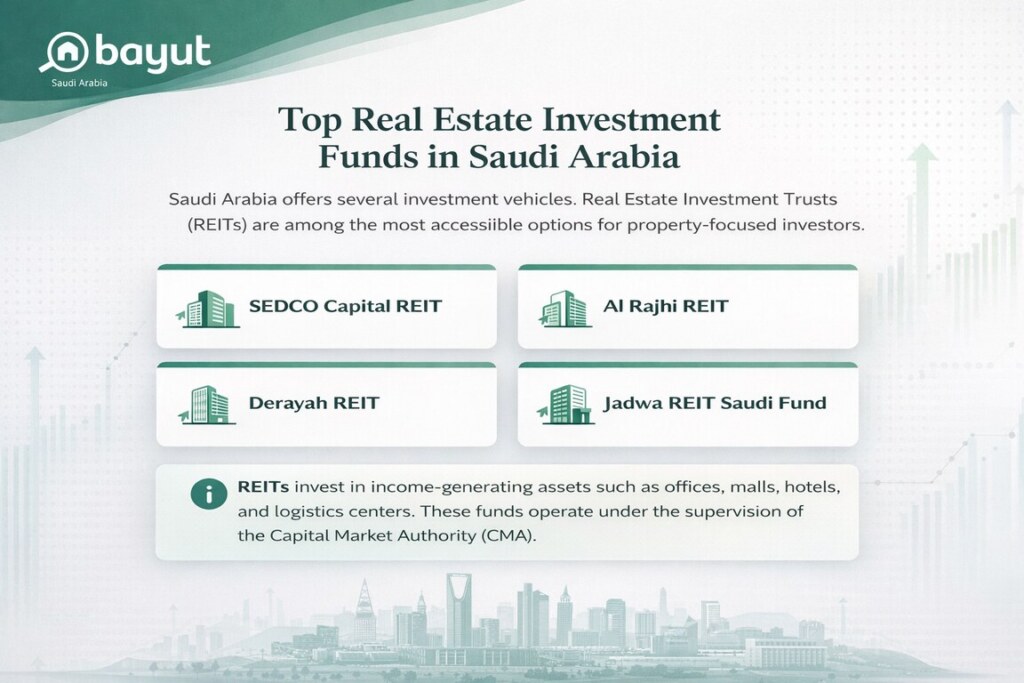
These developments are strengthening the case for institutional capital entering Saudi Arabia’s property market.
Impact of Institutional Investment on Real Estate Markets
Institutional investors often play an important role in shaping real estate markets.
Their participation can:
- Support large development projects
- Increase capital availability for property investments
- Improve transparency and market standards
- Encourage long-term investment planning
As more institutional capital enters a market, property sectors often become more structured and financially mature.
Bayut KSA: Invest with Confidence
Institutional investors rely on clear market information before allocating capital. Access to reliable property data and local insights is essential for evaluating investment opportunities.
The Bayut-KSA’s investor hub platform supports this process by providing:
- Verified property listings across major Saudi cities
- District-level pricing visibility
- Access to residential, commercial, and logistics opportunities
- Structured insights for investors exploring the Saudi market
For investors assessing the Kingdom’s evolving property landscape, transparent market data helps support informed investment decisions.





 as a preferred source on Google