
Highlights
- What is Saudi Arabia’s interest rate?
- interest rate in saudi arabia and Inflation Control
- Saudi Arabia Repo Rate
- Frequently Asked Questions
Did you know what the interest rate in saudi arabia is and how it influences the entire financial system? This important economic measure plays a major role in influencing borrowing costs, guiding investment decisions, and supporting overall market stability across the Kingdom.
Continue reading to learn more about how it impacts banks, loans, and the broader economy.
What is Saudi Arabia’s interest rate?

The interest rate in saudi arabia is a core monetary policy tool managed by the Saudi Central Bank. It is used to regulate liquidity within the economy and maintain financial stability during different economic cycles such as growth, slowdown, or inflation.
SAMA determines the cost of borrowing between banks, whether overnight or for longer periods. This directly affects financing products such as personal loans and mortgage solutions offered by financial institutions.
As of March 2026, the benchmark repo rate stands at approximately 4.25 percent, reflecting a stable monetary policy stance. Historically, interest rates in Saudi Arabia have averaged around 3.64% since 1992, reaching a peak of 7.00% in May 2000 and a record low of 1.00% in March 2020.

Key Interest Rate Indicators
Understanding the key interest rate indicators helps explain how monetary policy is applied in Saudi Arabia and its impact on the economy:
Indicator | Description |
|---|---|
Indicator SAIBOR | Description Interbank rate used within Saudi Arabia |
Indicator LIBOR | Description Global benchmark interest rate |
Indicator EURIBOR | Description Benchmark rate used across Europe |
Saudi Arabia follows a fixed exchange rate system, pegging the Saudi Riyal to the US Dollar at SAR 3.75 since 1986. This policy strongly influences interest rate movements, often aligning them with decisions made by the US Federal Reserve to maintain currency stability.
Additional Insight on the Interest Rate in Saudi Arabia and Monetary Policy Dynamics
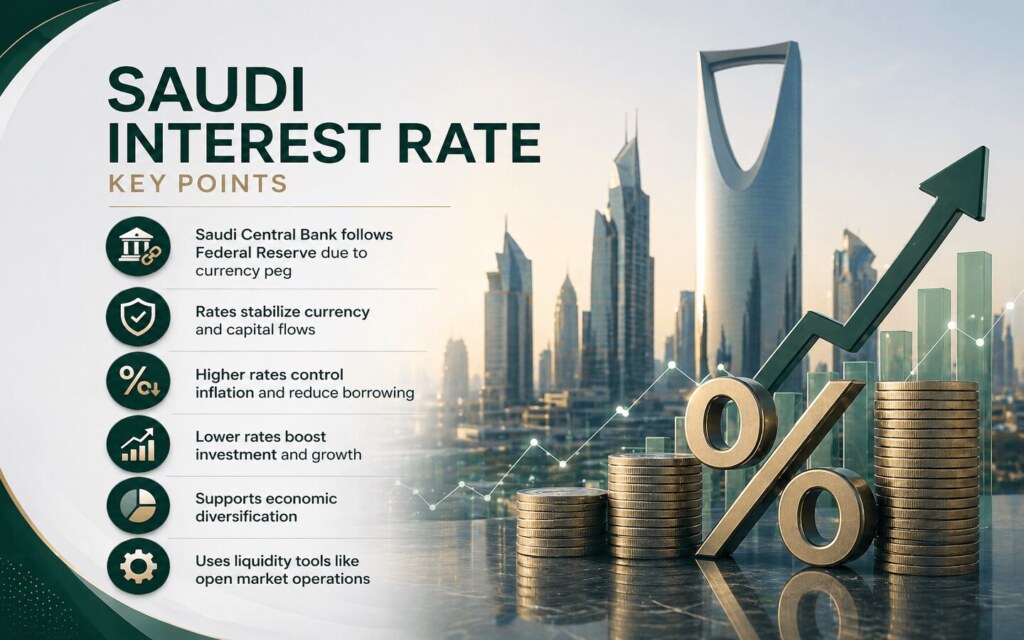
Beyond the main interest rate framework, Saudi Arabia’s monetary policy operates through several interconnected mechanisms that help maintain economic stability and support long term growth. These elements work together with interest rate decisions to ensure a balanced and resilient financial system.
- SAMA aligns its interest rate decisions with global monetary trends, especially US Federal Reserve policies, due to the Saudi Riyal’s peg to the US Dollar.
- Interest rate adjustments help maintain currency stability and ensure smooth capital flows in and out of the Saudi economy.
- Higher interest rates reduce borrowing and help control inflation, while lower rates encourage lending, investment, and economic growth.
- The interest rate in saudi arabia also supports national economic diversification goals by influencing business and consumer spending behavior.
- SAMA uses additional tools such as open market operations and reserve requirements alongside interest rates to manage liquidity in the banking sector effectively.
interest rate in saudi arabia and Inflation Control
A crucial aspect of the interest rate in saudi arabia is its strong connection to inflation management and the preservation of purchasing power. To better understand this relationship, the following table summarizes how interest rate decisions influence inflation, borrowing behavior, and overall economic stability.
Economic Condition | Interest Rate Action by SAMA | Economic Impact |
|---|---|---|
Economic Condition Rising inflation | Interest Rate Action by SAMA Increase interest rates | Economic Impact Reduces borrowing, slows spending, helps control price increases |
Economic Condition Low inflation or slowdown | Interest Rate Action by SAMA Decrease interest rates | Economic Impact Encourages borrowing, boosts demand, supports economic growth |
Economic Condition Stable economy | Interest Rate Action by SAMA Maintain or adjust gradually | Economic Impact Ensures balanced liquidity and financial stability |
Do Saudi Arabian banks have interest?
Saudi Arabian banks operate within a system influenced by Islamic finance principles. While traditional interest is not applied in its conventional form, banks provide financing solutions based on profit sharing and structured agreements.
In practice, the interest rate in saudi arabia is still used as a benchmark to determine the pricing of financial products such as:

- Home financing
- Personal loans
- Corporate funding
Also read: Saudi Arabia Mortgage 2026: Rates, REDF & Expat Home Loans
Saudi Arabia Repo Rate
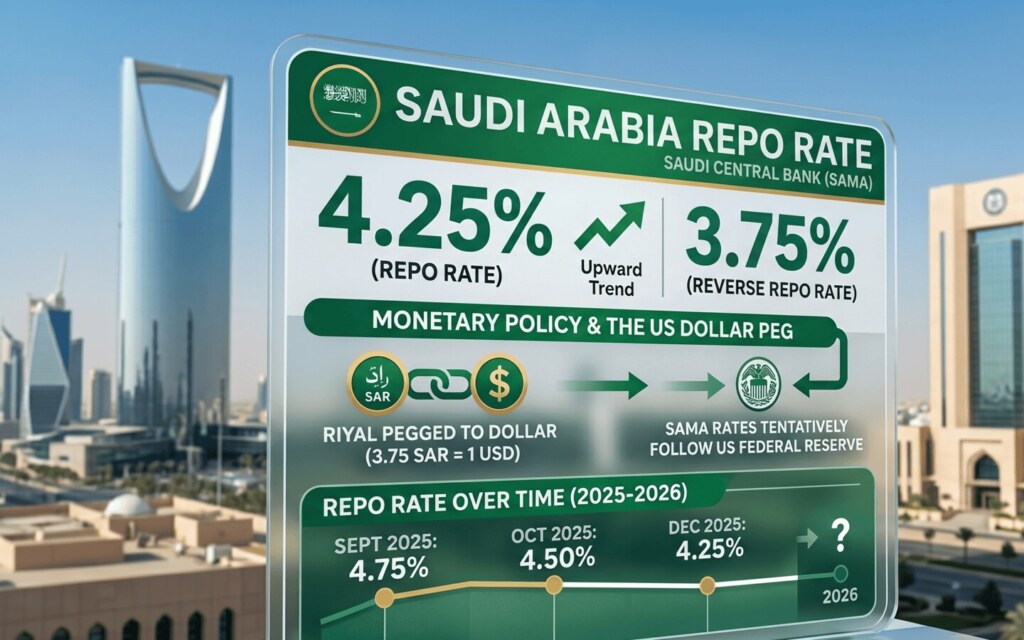
The repo rate is the official interest rate set by the Saudi Central Bank and represents the rate at which commercial banks borrow funds from the central bank. It serves as the primary benchmark for monetary policy in the Kingdom.
Current Monetary Indicators
The following table presents the most recent monetary indicators that reflect the current interest rate environment in Saudi Arabia and its key benchmarks:
Indicator | Value | Date |
|---|---|---|
Indicator Repo Rate | Value 4.25% | Date March 2026 |
Indicator Reverse Repo Rate | Value 3.75% | Date March 2026 |
Indicator Interbank Rate | Value 4.84% | Date February 2026 |
Historical Interest Rate Movements
Saudi Arabia has actively adjusted interest rates to maintain economic stability:
- In 2020, rates were reduced significantly to support the economy during global disruptions
- Between 2022 and 2023, rates increased multiple times to control inflation
- In 2025, rates were reduced again in alignment with global monetary trends
Frequently Asked Questions
Below are some of the most frequently asked questions that help clarify common points about iinterest rate in saudi arabia and how they work in practice:
There is no specific bank in Saudi Arabia that consistently offers a fixed 7% interest rate. This figure represents a historical peak rather than a standard rate offered by banks. Actual rates vary depending on market conditions and loan types.
Saudi Arabia has banks that provide financing services aligned with Islamic finance principles. While traditional interest is not explicitly used, profit based financial structures serve similar purposes in practice.
Some countries have implemented near zero interest rates during economic downturns, such as Japan and certain European economies. However, maintaining a strict 0% rate is uncommon over the long term.
A 9.5% rate is not typical in Saudi Arabia. Financing rates depend on economic conditions, central bank policies, and the type of financial product rather than fixed offerings by specific banks.
To conclude, we have explored the interest rate in saudi arabia its role in regulating liquidity, and its impact on banks and the broader economy. We also examined the repo rate and key monetary indicators that shape financial decisions in the Kingdom. We invite you to visit Bayut blog to stay updated with the latest insights and developments.




 as a preferred source on Google