
What is Financial Statement Analysis and why is it important? It helps investors and businesses assess a company’s performance, profitability, and stability to make informed financial decisions.
Continue reading to explore key techniques and their application in Saudi Arabia.
What Is Financial Statement Analysis?
Financial Statement Analysis is the process of examining a company’s financial reports to evaluate its performance, financial position, and future potential. Analysts use statements such as the income statement, balance sheet, and cash flow statement to assess profitability, growth, and the company’s ability to meet its financial obligations.
In Saudi Arabia, financial reporting transparency has improved through regulatory frameworks and the adoption of International Financial Reporting Standards IFRS, which helps investors compare companies and make more informed financial decisions.
Financial Statement Analysis Techniques
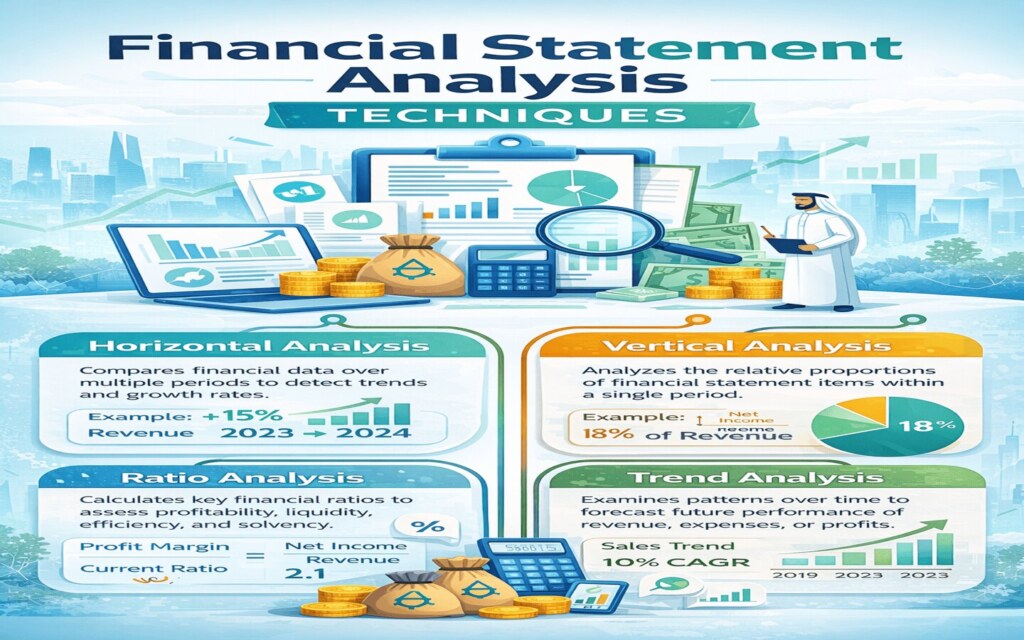
To interpret financial statements effectively, analysts rely on several well established techniques. Each method provides a different perspective on a company’s financial performance and stability.
Below are the most widely used techniques in Financial Statement Analysis:

Horizontal Analysis
Horizontal analysis focuses on comparing financial data across multiple accounting periods. Analysts evaluate the changes in revenue, expenses, assets, and liabilities over time to identify trends and growth patterns.
For example, consider a Saudi company’s recent revenue performance:
Year | Revenue SAR | Change |
|---|---|---|
Year 2023 | Revenue SAR 8,200,000 | Change — |
Year 2024 | Revenue SAR 9,450,000 | Change +15% |
Year 2025 | Revenue SAR 10,700,000 | Change +13% |
Vertical Analysis
Vertical analysis examines each item in a financial statement as a percentage of a base figure. For example, in the income statement, every expense is often expressed as a percentage of total revenue.
This technique allows analysts to evaluate cost structures and profitability ratios within a single reporting period, making it easier to compare companies of different sizes.
Item | Amount | Percentage of Revenue |
|---|---|---|
Item Revenue | Amount 1,000,000 | Percentage of Revenue 100% |
Item Cost of Goods Sold | Amount 600,000 | Percentage of Revenue 60% |
Item Operating Expenses | Amount 250,000 | Percentage of Revenue 25% |
Item Net Profit | Amount 150,000 | Percentage of Revenue 15% |
Ratio Analysis
Ratio analysis is one of the most widely used tools in Fiscal Performance Evaluation. It involves calculating financial ratios to evaluate profitability, liquidity, efficiency, and solvency.
Common examples include:
Ratio Type | Example Ratio | Purpose |
|---|---|---|
Ratio Type Liquidity Ratios | Example Ratio Current Ratio | Purpose Measures ability to pay short term obligations |
Ratio Type Profitability Ratios | Example Ratio Net Profit Margin | Purpose Evaluates overall profitability |
Ratio Type Efficiency Ratios | Example Ratio Asset Turnover | Purpose Measures how efficiently assets generate revenue |
Ratio Type Solvency Ratios | Example Ratio Debt to Equity | Purpose Assesses long term financial stability |
Cash Flow Analysis
Cash flow analysis focuses on how cash moves in and out of a business. While profitability is important, companies must also maintain sufficient cash flow to cover operational costs, repay debt, and invest in growth opportunities.

Analysts often examine three main cash flow components:
- Operating cash flow
- Investing cash flow
- Financing cash flow
Applying Financial Statement Analysis in Saudi Arabia

Financial Statement Analysis plays an important role in Saudi Arabia, especially as the Kingdom continues to strengthen its financial markets in line with Vision 2030. Companies in the country prepare and submit audited financial statements, including the balance sheet, income statement, and cash flow statement, to regulatory authorities such as the Ministry of Commerce and the Zakat, Tax and Customs Authority.
In addition, the Capital Market Authority requires publicly listed companies to disclose annual and interim financial reports to maintain transparency and protect investors. Within this framework, investors use Financial Statement Analysis to evaluate opportunities, banks assess creditworthiness before lending, and companies and government entities monitor financial performance and make strategic decisions.
Saudi Arabia also applies International Financial Reporting Standards, which improves transparency and allows both local and international investors to analyze companies using globally recognized financial reporting practices.
Also Read: Opening Saudi Arabia Financial Market
Frequently Asked Questions
Below are some common questions related to Fiscal Performance Evaluation:
It helps investors, lenders, and managers understand a company’s financial performance, identify risks, and make informed financial decisions.
The main financial statements include the balance sheet, income statement, cash flow statement, and notes to the financial statements.
Financial analysts, investors, lenders, regulators, and corporate managers commonly rely on Fiscal Performance Evaluation to evaluate a company’s financial health.
Saudi Arabia uses International Financial Reporting Standards IFRS endorsed by the Saudi Organization for Chartered and Professional Accountants to ensure transparency and consistency in financial reporting.
To conclude, we have reached the end of our article, where we explored Financial Statement Analysis, its key techniques, and its application in Saudi Arabia. These methods help investors and businesses evaluate financial performance and make informed financial decisions.
We invite you to explore more insightful articles about finance, investment, and the real estate market by visiting the Bayut blog.




 as a preferred source on Google