Saudi Arabia offers more than one route for investors looking to participate in its economic growth. From listed assets and private businesses to property, the main types of investment in Saudi Arabia differ in cost, control, liquidity and risk.
The best choice depends on how much capital you want to commit, how quickly you may need access to your money and how actively you want to manage the investment. For a wider view of property-led opportunities, Bayut-KSA’s Invest in Saudi hub offers a useful starting point.
What are the Main Types of Investment in Saudi Arabia?
The three broad investment routes are:
- Financial market investments for liquidity and portfolio diversification.
- Direct business investments & foreign ownership for greater control and long-term business growth.
- Real estate investments for rental income, capital appreciation and tangible asset ownership.
Some investors focus on one route, while others combine different assets to spread risk.
Financial Market Investments
For investors who want exposure to Saudi companies without directly operating a business, the capital markets offer a more flexible route. These financial market investments can provide access to different sectors while allowing investors to build a diversified portfolio.

Common options include:
- Shares listed on the Saudi Exchange
- Sukuk and other debt instruments
- Exchange-traded funds
- Investment funds
- Real Estate Investment Trusts (REITs)
This route may suit investors who value liquidity because listed assets can generally be bought and sold more easily than a physical property or private business. It also allows investors to diversify across sectors rather than placing all their capital in one asset.
Foreign participation in Saudi securities is regulated by the Capital Market Authority, so investors should check the rules that apply to their investor category and use authorised market institutions.

Direct Business Investments & Foreign Ownership
Entrepreneurs and companies seeking a more active role can put capital directly into an operating company, startup, branch, partnership or new venture. This makes direct business investments & foreign ownership particularly relevant for investors pursuing control and long-term market expansion.
Investors may need to manage:
- Business registration and licensing
- Regulatory compliance
- Hiring and operations
- Tax and accounting obligations
- Local market research
- Sector-specific conditions
Under Saudi Arabia’s updated investment framework, foreign investors generally need to register with the Ministry of Investment before carrying out investment activities. They can then complete commercial registration and obtain any necessary licences from relevant authorities.

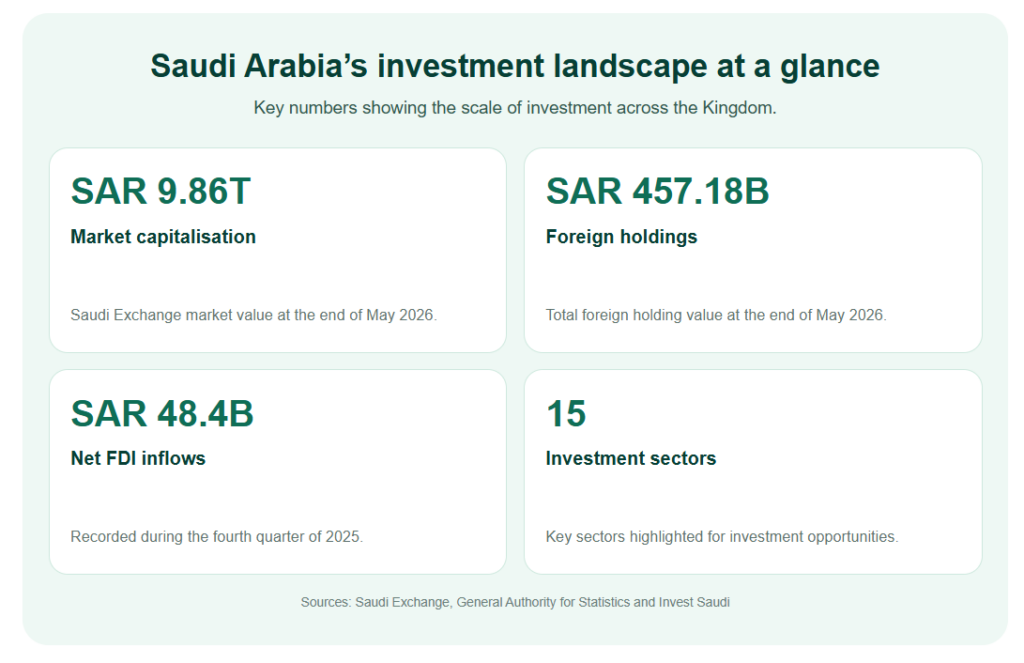
Compared with listed investments, direct business ownership can require more time and specialist knowledge. It may be better suited to investors planning a long-term presence in the Kingdom.
Real Estate Investments
Property offers another route for those looking for rental income, long-term asset growth or portfolio diversification. Across the Kingdom, real estate investments can range from residential units and commercial spaces to off-plan developments and indirect property models.
Options include:
- Residential apartments and villas
- Long-term rental properties
- Furnished and daily rental units
- Commercial offices and retail spaces
- Warehouses and logistics properties
- Off-plan developments
- Land
- REITs and fractional property models
Saudi Arabia’s updated non-Saudi real estate ownership framework entered into force on 22 January 2026. Ownership remains subject to legal conditions and geographical parameters, so foreign buyers should check eligibility before making a purchase.
Investors exploring this route can read Bayut-KSA’s guide to real estate investment in Saudi Arabia or compare different ways to make money from real estate.
Three Ways to Invest in Saudi Arabia
Compare the main routes by goal, liquidity and level of involvement.
Financial Markets
Direct Business
Real Estate
Which Investment Type Matches Your Goal?
A simple way to compare the main options is:
- Choose financial markets for liquidity, diversification and a more passive approach.
- Choose direct business investment for control, operational growth and long-term market entry.
- Choose real estate for tangible assets, rental income and potential capital appreciation.
A mixed strategy can also work. An investor might hold listed assets for liquidity, invest in a business for growth and add property for income.
Choosing the Right Investment Path
The right option depends on your capital, risk tolerance, time horizon and preferred level of involvement. Understanding the different types of investment in Saudi Arabia makes it easier to compare opportunities before committing funds.
For investors leaning towards property, Bayut-KSA offers a practical place to compare listings, explore locations and understand real estate opportunities across the Kingdom before taking the next step.





 as a preferred source on Google