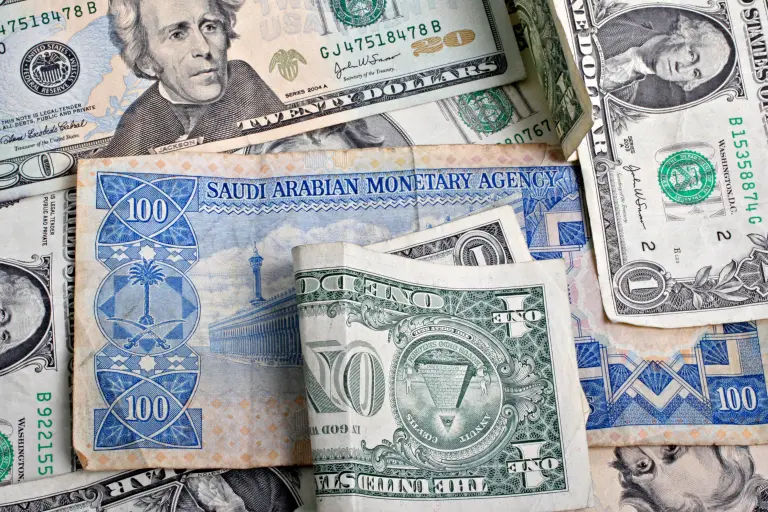
Currency risk can quietly erode a strong property return. An asset may rise in value and generate steady rent, yet part of that gain can disappear if the local currency weakens. Saudi Arabia substantially reduces that exchange-rate uncertainty against the US dollar through the SAR-USD peg. A currency peg simply means keeping one currency at a fixed rate against another. The Saudi riyal has been effectively pegged at SAR 3.75 per USD since 1986, a rate maintained by the Saudi Central Bank, SAMA.
For Saudi property investors, it creates greater visibility over property values, rental income and eventual sale proceeds when measured in dollars.
How the SAR-USD Peg Works
Saudi Arabia does not allow the riyal to float freely against the US dollar. Instead, SAMA maintains the exchange rate at SAR 3.75 for USD 1.
The arrangement is not merely historical. In its 2026 Article IV assessment, the IMF said the currency peg remains appropriate for Saudi Arabia’s economic structure, is supported by ample external buffers and continues to provide a credible monetary-policy anchor.
The peg does not guarantee a property return. It simply removes one important moving part from the equation.
Why Currency Stability Matters for Property Investors
International property has two sources of movement: the asset and the currency. Imagine a property rises 8% in local-currency terms. If that currency then falls sharply against the investor’s home currency, part of the gain can disappear when the proceeds are converted back.
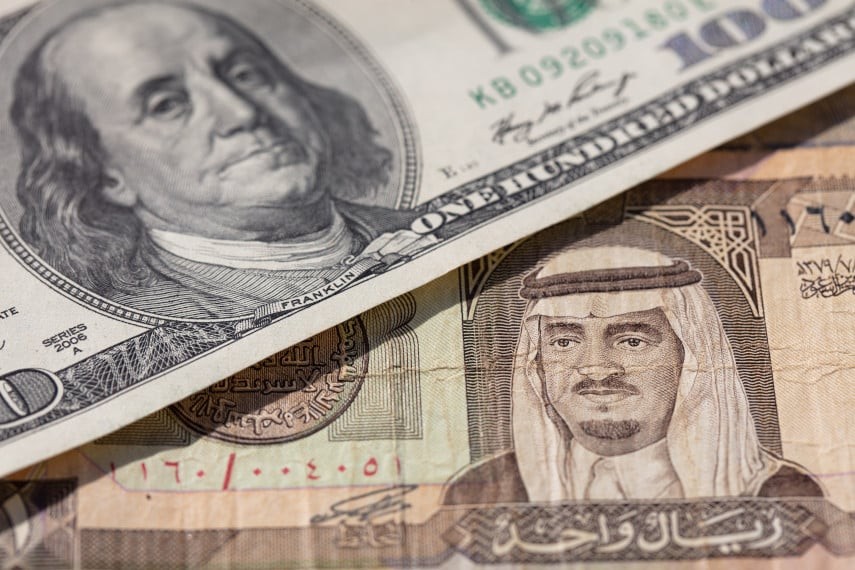
The SAR-USD peg greatly reduces that risk for investors measuring their wealth in dollars. A SAR 1.5 million property corresponds to about USD 400,000 at the fixed rate. The investor can focus more closely on whether the property itself is performing instead of trying to forecast a second market in the background. That makes Saudi property easier to model over a long holding period.

The SAR-USD Peg Makes Rental Income Easier to Read
The same advantage applies to rent.
A property generating SAR 75,000 annually represents about USD 20,000 at SAR 3.75 per dollar. If the riyal floated freely, the dollar value of that rent could change even when the landlord collected exactly the same amount in Saudi currency.
With the peg, investors gain more visibility over:
- Annual Rental Income
- Indicative Rental Yield
- Dollar-Based Cash Flow
- Property Value
- Target Exit Value
- Long-Term Return Planning
Occupancy and local rents can still rise or fall. The difference is that ordinary SAR-USD exchange-rate swings are largely taken out of the picture.
The Peg Matters When You Sell Too
Currency risk often becomes most painful at the exit. An overseas property may appreciate for years, only for the local currency to weaken shortly before the owner sells. The investor then converts a stronger property price through a weaker exchange rate.
The SAR-USD peg largely prevents ordinary SAR-USD exchange-rate swings from eroding a property’s dollar value. If a property’s SAR value rises, a dollar-based investor does not normally need an additional currency gain from the riyal to preserve that increase in USD terms, assuming the peg remains in place. That creates a cleaner link between property performance and dollar value.

What Does the Peg Mean for UK, Indian and Other Buyers?
For investors whose home currency is not the US dollar, the peg simplifies rather than eliminates currency risk.
A UK buyer remains exposed to GBP-USD movements. An Indian buyer still faces INR-USD movements, while a Pakistani investor remains exposed to PKR-USD changes. What they generally do not face is a second freely floating SAR-USD exchange rate on top of that exposure.
In practical terms, Saudi property behaves more like a dollar-linked asset from a currency perspective. That can make the investment easier to compare with property markets whose local currencies move independently.
The Peg Comes With an Interest-Rate Trade-Off
Currency stability has a cost. Because Saudi Arabia maintains the dollar peg alongside an open capital account, SAMA’s policy-rate decisions remain closely aligned with those of the US Federal Reserve. The IMF reiterated this relationship in its 2026 assessment.
For financed property buyers, that matters. When US rates are high, Saudi borrowing costs can remain elevated too. Cash investors feel this less directly. Leveraged buyers should therefore weigh financing costs alongside rental yield and capital-growth expectations.
The Peg Cannot Rescue the Wrong Property
Currency stability improves visibility. It does not turn every Saudi property into a good investment. Investors still need to examine:
- Purchase Price
- Rental Demand
- Vacancy Risk
- Service Charges
- Maintenance Costs
- Financing Costs
- Handover Risk
- Foreign Ownership Eligibility
- Resale Liquidity
- Indicative Net ROI
Foreign ownership has also become more relevant since Saudi Arabia’s updated non-Saudi property ownership system entered into force on 22 January 2026. REGA confirms that the framework covers residents, non-residents and non-Saudi companies and entities, subject to the applicable legal controls and procedures.
Why the SAR-USD Peg Strengthens Saudi Property Investment
The SAR-USD peg gives Saudi property something international investors value highly: predictability. The latest IMF assessment continues to describe the peg as appropriate, supported by ample external buffers and useful for financial stability. Earlier IMF data also showed SAMA’s net foreign assets at about USD 415 billion at the end of 2024, equivalent to 187% of the IMF’s reserve-adequacy metric.
- That does not remove market risk, financing risk or property-specific risk. What it does is reduce uncertainty between the riyal and the world’s dominant reserve currency.
- For a long-term property investor, that can make purchase prices easier to compare, rental income easier to model and an eventual exit easier to plan.
- The peg is not the investment case by itself. It is one of the features that can make a strong Saudi property investment easier to understand and hold.
Frequently Asked Questions
What Is the SAR-USD Peg?
The SAR-USD peg is Saudi Arabia’s fixed exchange-rate arrangement with the US dollar. The riyal has effectively been maintained at SAR 3.75 per USD since 1986.
How Does the SAR-USD Peg Protect Property Investors?
It reduces ordinary exchange-rate volatility between the Saudi riyal and US dollar. That gives investors greater visibility over property values, rental income and future sale proceeds when measured in USD.
Does the SAR-USD Peg Guarantee Property Returns?
No. Property prices, rents, vacancy, costs and financing conditions can still change. The peg primarily reduces SAR-USD currency risk.
Do UK and Indian Investors Still Face Currency Risk?
Yes. A UK investor remains exposed to GBP-USD movements, while an Indian investor faces INR-USD movements. The peg simplifies that exposure because the SAR-USD leg remains fixed under the current exchange-rate regime.
Can the Saudi Riyal Peg Change?
No fixed exchange-rate system is guaranteed forever. However, the peg has been maintained at SAR 3.75 per USD since 1986, and the IMF’s 2026 assessment continues to describe the arrangement as appropriate and supported by ample external buffers.




 as a preferred source on Google