
Saudi Arabia is executing infrastructure at a national scale. Land availability now directly affects project speed, cost control, and sequencing. The Real Estate Expropriation System in Saudi Arabia, effective in 2026, sets the legal and procedural framework for how private land is acquired for public use, defining compensation, authority, and limits within that process.
Real Estate Expropriation System
Large-scale public projects require land assembly that cannot rely on bilateral market transactions alone. The system establishes a controlled legal pathway to secure land while preserving ownership rights.
- Enables government entities to permanently expropriate or temporarily possess private real estate
- Limited strictly to projects approved as serving public benefit
- Applies across infrastructure, utilities, transport, housing, and strategic urban development
- Operates under statutory limits, not discretionary administrative action
- Requires formal designation, valuation, notification, and compensation before possession
Law of Expropriation of Real Estate for Public Benefit
The previous legal framework was designed for isolated projects, not national-scale delivery. The updated law reflects the operational reality of multi-region infrastructure rollout.

- Published in Umm Al-Qura on 19 September 2025
- Entered into force on 17 January 2026, following the statutory 120-day period
- Replaced the 2003 expropriation law, which lacked unified timelines and valuation standards
- Governs both permanent expropriation and temporary possession
- Establishes a single national framework applicable across all regions and authorities
New Expropriation System 2025/2026: Key Changes
The reform focused on execution discipline rather than expanding state power. The objective was to reduce delay, variance, and funding risk in public projects.
- Unified procedures across ministries, municipalities, and public authorities
- Reduced regional discretion in valuation and process sequencing
- Authorities must demonstrate no viable state-owned land alternative before expropriation
- Compensation funding must be secured in advance, not after possession
- Digitalized notice, inventory, valuation, and payment documentation
Compensation Rules
Compensation is now formula-driven to reduce disputes and delays. Valuation consistency is a project-enabling requirement.

- Compensation set at fair market value plus a statutory 20% uplift for permanent expropriation
- Temporary possession compensated at market rental value plus uplift
- Valuation conducted by three independent valuers accredited by TAQEEM
- Licensed buildings, crops, and permanent improvements included
- Speculative future rezoning, unapproved use, and development assumptions excluded
Procedural Timelines & Owner Rights
Timelines now function as enforceable safeguards rather than guidelines. Delay carries defined legal consequences for the expropriating authority.
- Structured timelines govern approval, inventory, valuation, and payment stages
- Owners retain formal objection and judicial review rights at defined stages
- If compensation is delayed beyond three years, owners may request revaluation
- Revaluation cannot reduce the original compensation amount
- Payment timing is legally tied to possession rights
Temporary Possession of Real Estate
Not all public projects require permanent acquisition. Temporary possession addresses construction and access needs without ownership transfer.
- Used for infrastructure, utilities, and time-bound public works
- Initial possession period capped at three years
- Extensions permitted only under defined regulatory approval
- Compensation payable throughout the possession period
- Legal ownership remains with the private owner at all times
Sector-Level Implications
The real estate expropriation system in Saudi Arabia affects asset classes unevenly due to location and use intensity. Function drives regulatory exposure more than price.
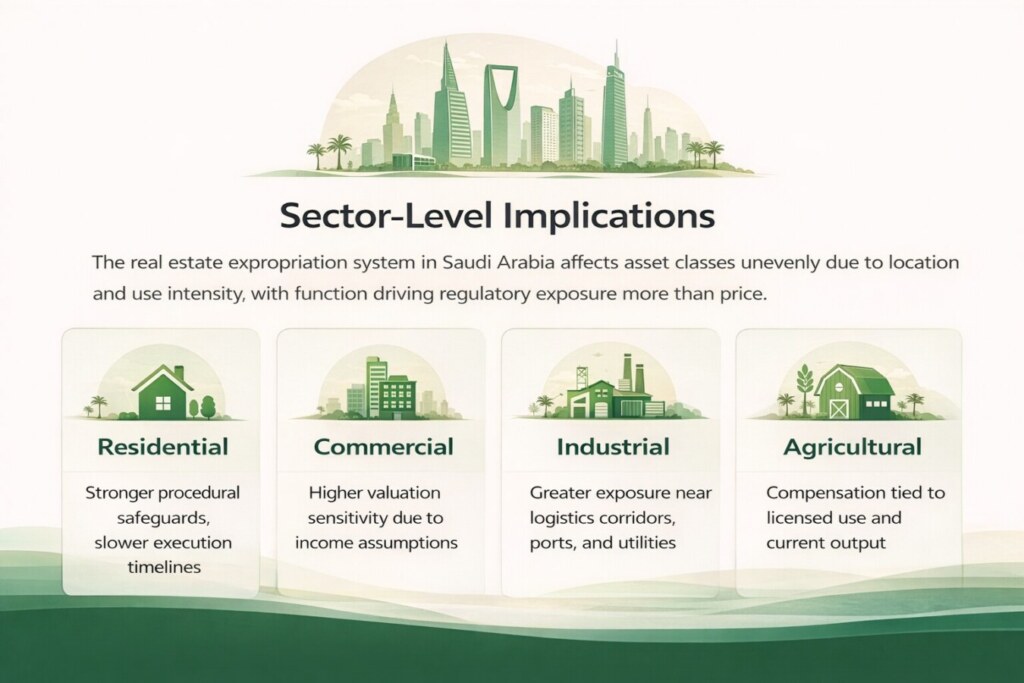
- Residential: stronger procedural safeguards, slower execution timelines
- Commercial: higher valuation sensitivity due to income assumptions
- Industrial: greater exposure near logistics corridors, ports, and utilities
- Agricultural: compensation tightly linked to licensed use and current output
Bayut-KSA: Market Signals in Expropriation-Sensitive Areas
As land assembly becomes more centralized, market signals appear earlier.
- Tracks pricing and listing density across Saudi cities
- Highlights shifts near infrastructure and transport corridors
- Supports comparison of pre- and post-announcement pricing
- Aids early location-level risk screening
Bayut-KSA serves as a market intelligence reference for understanding pricing behavior in areas affected by public development and expropriation activity.





 as a preferred source on Google