
The Digitization of the real estate title deed in Saudi Arabia emerged from a practical need. As transaction volumes increased and financing activity expanded, paper-based ownership records began to slow processes and create administrative risk. Manual verification and physical documentation limited the efficiency of a market that was growing rapidly.
To address this, Saudi Arabia modernized its registry infrastructure. Integrated within the broader transformation under Saudi Vision 2030, digitization strengthens how ownership is recorded, verified, and transferred across the Kingdom, reinforcing the legal foundation of every property transaction.
The Numbers Behind Digitization
Official updates confirm national rollout at scale.
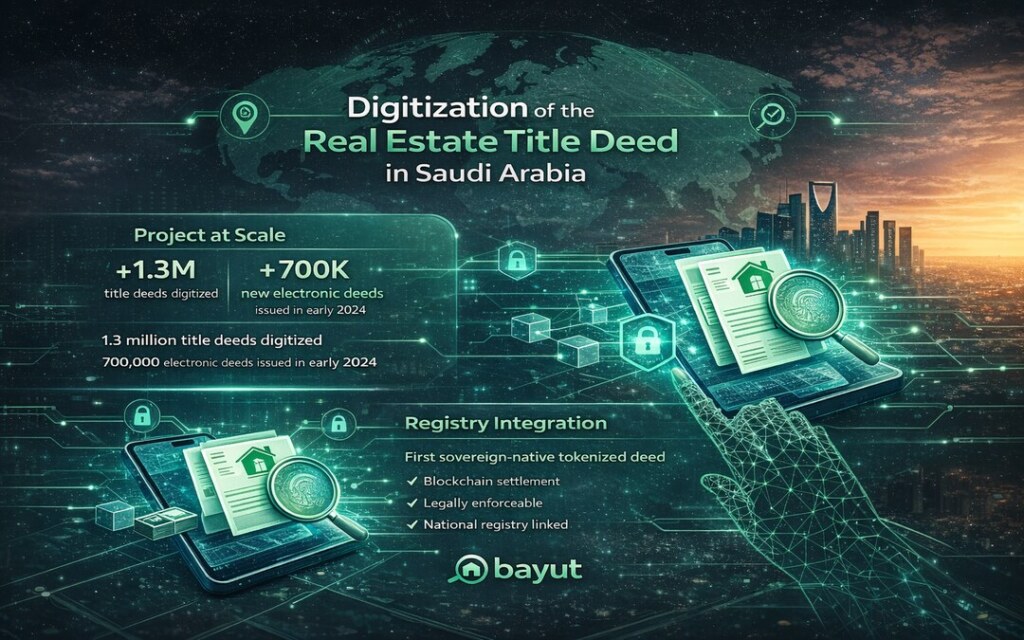
- The Ministry of Justice has digitized more than 1.3 million title deeds.
- Over 700,000 deeds were issued digitally in early 2024 alone.
- Authorities launched a centralized digital real estate registry platform to manage property and corporate ownership services.

Government-Backed Tokenized Title Transfer
In 2024–2025, Saudi Arabia executed the world’s first sovereign-native tokenized property title deed transaction. Authorities integrated blockchain settlement directly into the national property registry.
The transaction featured:

- Settlement completed in seconds
- Digital title linked to the official registry database
- Legal enforceability maintained under state supervision
- Blockchain used strictly as settlement infrastructure
Read more about fractional real estate investment to understand registry-backed tokenization.
Structural Impact on Property Transactions
Previously, transfers depended on manual validation, paper files, and in-person approvals. That structure created delays and documentation risk. Today, digital systems streamline the process.
Registry integration now enables:
- Real-time ownership verification
- Electronic title issuance
- Direct linkage with national identity records
- Reduced duplication and paperwork
- Shorter approval cycles
Obtaining a Digital Title Deed
Authorities process digitization through two official platforms:
- Real Estate Register, supervised by the Real Estate General Authority
- Najiz Portal, operated by the Ministry of Justice
The process follows structured steps:

- Log in to the Najiz portal using national authentication.
- Submit deed details and ownership information.
- Verify cadastral and identity data.
- Complete electronic validation within the Real Estate Register system.
Under the new Non-Saudi Property Ownership Law, Saudi Arabia’s property system now allows foreign buyers to submit property ownership applications digitally via the official digital registration platform.
Updating a Digitized Title Deed
Owners must update records whenever legal status changes. Updates occur through Najiz and are recorded in the Real Estate Register under regulatory supervision.
An update is required when:
- Ownership transfers
- A mortgage is registered or released
- A plot is merged or subdivided
- Legal ownership details change
The system verifies the request electronically. Once approved, authorities update the registry and issue the revised digital record.
Investor and Market Implications
The Digitization of the Real Estate Title Deed continues to redefine how ownership security and transaction efficiency operate across Saudi Arabia’s property market.
Centralized digital records improve:
- Transaction speed
- Ownership clarity
- Documentation accuracy
- Mortgage processing
- Transparency across transfers
As registry clarity improves, perceived risk declines. In turn, stronger capital participation supports market liquidity.
Explore Verified Listings with Bayut-KSA
Ownership security forms the base of property value. Access to verified market data strengthens investment positioning.
On Bayut-KSA, buyers and investors can explore verified listings supported by structured location insights and transparent property data. As Saudi Arabia advances digital registry infrastructure, informed decision-making becomes increasingly critical.





 as a preferred source on Google