
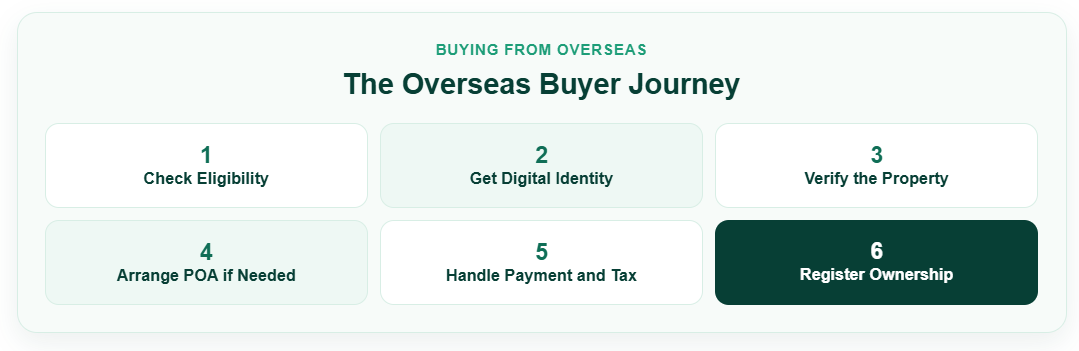
To buy Saudi property from abroad in 2026, overseas investors need to follow the process in the right order. The journey starts with eligibility and property checks, then moves through digital identity, representation where required, payment, tax and final registration.
Saudi Arabia’s updated non-Saudi ownership framework is designed to accommodate buyers who live outside the Kingdom. If you plan to buy Saudi property from abroad, understanding the official process before committing funds can prevent unnecessary delays and costly mistakes.
Step 1. Check Your Eligibility to Buy Saudi Property from Abroad
The first question is not whether you like the property. It is whether you are allowed to acquire it.
When you buy Saudi property from abroad, due diligence becomes even more important. You may not have walked through the property yourself, so the documents, ownership record and seller or developer background need careful review.
Important checks include
- Whether the Property Is in an Eligible Geographic Zone
- Whether Your Buyer Category Can Acquire That Property
- Whether the Type of Real Right Is Permitted
- Whether Any Ownership Percentage Limits Apply
- Whether Any Usufruct Duration Limits Apply
- Whether Special Rules Apply to Makkah or Madinah
Makkah and Madinah remain subject to additional restrictions. Non-Saudi individual ownership in the two holy cities is restricted to Muslims under the current framework.
The safest order is simple. Confirm your eligibility first, and only then start negotiating the transaction.
Step 2. Obtain the Required Digital Identity
Non-resident buyers have a different starting point from people who already live in Saudi Arabia.
The overseas route begins through the relevant Saudi representation abroad. The buyer obtains the digital identity required for the non-Saudi ownership process and then continues through the Saudi Properties platform.
This digital identity allows the system to recognise a non-resident buyer and connect the ownership process with the relevant Saudi government systems.
The important point is that an overseas buyer should follow the non-resident route designed for foreign ownership rather than assume that every standard domestic property-transfer step applies in exactly the same way.
Compare the Investment Before You Commit
Step 3. Verify the Property Before Signing
Remote buying makes due diligence more important. You may not have walked through the property yourself, so the documents and registration position become even more significant.
For a completed property, check the registered details and make sure the property matches what the seller is offering. For an off-plan purchase, verify the project licence, unit specifications, escrow arrangements and construction status.
Before signing, check
- The Seller or Developer
- The Exact Property or Unit
- The Registration Status
- Any Existing Rights or Encumbrances
- The Agreed Purchase Price
- The Payment Schedule
- The Handover or Completion Date
- Service Charges and Ongoing Costs
- Rental Potential
- Resale Demand
Due diligence should answer two separate questions. Is the transaction legally possible, and is the property commercially worth buying?
A property can pass the legal checks and still be a weak investment.
Step 4. Decide Whether You Need a Power of Attorney
A Power of Attorney can be useful when you are buying from another country, but it is not automatically required for every transaction. A properly structured POA can therefore make it easier to buy Saudi property from abroad without travelling for every permitted transaction step.

Depending on the transaction, a representative may assist with
- Submitting Documents
- Dealing With Relevant Authorities
- Signing Permitted Documents
- Completing Specified Transaction Steps
- Supporting the Ownership Transfer
The wording matters. A POA should clearly state what the representative is authorised to do.

Overseas buyers should also check whether the document needs notarisation, legalisation, authentication or Arabic translation before it can be used in Saudi Arabia.
A POA only provides authority to act. It does not override ownership restrictions or make an ineligible transaction valid.
Step 5. Check Escrow Before Paying for an Off-Plan Unit
Escrow becomes particularly important when the property has not yet been completed.
Licensed off-plan projects in Saudi Arabia operate with project-specific escrow arrangements. Buyer funds are placed into the designated project account, and withdrawals are controlled for project-related purposes.
That structure is designed to separate project money from unrestricted developer funds.

For licensed off-plan projects, the escrow account is linked to the specific development. Project withdrawals are subject to controls and approvals rather than being freely available to the developer.
Reservation payments are also regulated during the project marketing stage. The current framework limits the reservation amount to a percentage of the unit value and requires it to be handled through the designated project arrangements.
Escrow reduces one category of financial risk, but it does not guarantee rental returns, capital appreciation or timely completion. Investors should still assess the developer, location and project economics.
Step 6. Review the Purchase Agreement Carefully
The contract is where the commercial deal becomes a legal commitment.
Do not review only the purchase price. The agreement should explain exactly what is being purchased, when payments are due and what happens if either side fails to perform.
Check
- The Purchase Price
- The Deposit
- Payment Milestones
- The Property Description
- Completion or Handover Dates
- Default Provisions
- Delay Provisions
- Cancellation Terms
- Service Charges
- Responsibility for Transaction Costs
For an off-plan unit, the agreement should also match the licensed project information and the unit specifications being marketed.
Do not assume that signing the contract means ownership has already transferred. Registration remains a separate step.
Step 7. Make Payments Through the Correct Route
The payment method depends on what you are buying.
For a regulated off-plan purchase, project payments should follow the applicable escrow arrangements. Investors should avoid transferring project funds to unrelated personal or informal accounts.

For completed property, payments should follow the approved transaction and transfer process.

The key distinction is that money and ownership are not the same thing. A payment receipt proves that funds moved. It does not by itself prove that the property has been legally registered in your name.
Keep records of every payment, transfer reference and bank confirmation.
Step 8. Budget for RETT and Other Costs
The advertised property price is not the final acquisition cost.
Saudi Arabia’s Real Estate Transaction Tax is currently 5%, subject to the applicable rules and exemptions. Overseas buyers should therefore calculate the full transaction cost before deciding how much they can afford to invest.
Other possible costs include
- Legal or Advisory Fees
- Property Valuation
- Bank Transfer Charges
- Power of Attorney Costs
- Translation or Authentication
- Registration or Service Fees Where Applicable
- Developer or Community Charges
- Property Management
- Initial Furnishing
Non-Saudi ownership rules can also create additional transaction-specific fees in certain cases. The exact treatment depends on the property, city and type of disposition, so buyers should confirm the current fee position before completing the deal.
A property that fits your headline budget can become much less attractive once taxes and additional costs are included.
Step 9. Complete the Ownership Transfer
Once the commercial and financial requirements are complete, the transaction moves to formal ownership transfer.
The property needs to meet the applicable registration requirements. Any required approvals, tax references and representative documentation should also be ready before completion.
Depending on the transaction, the process may involve
- Selecting the Property
- Completing the Transfer Application
- Attaching the Required Documents
- Providing Any Required POA
- Completing Applicable Tax Requirements
- Paying Relevant Fees
- Submitting the Transfer
For a non-resident foreign buyer, the exact digital process should follow the Saudi Properties framework designed for non-Saudi ownership.
Do not assume that every screen or authentication step shown in a generic domestic transfer guide applies unchanged to an overseas buyer.
Step 10. Verify the Final Registration
The final step is to confirm that the property or real right has actually been recorded in your name.
Do not stop at payment, possession of the keys or a signed purchase contract. The registration position matters.
After completion, verify
- The Registered Owner
- The Property Details
- The Real Right Acquired
- Any Recorded Restrictions
- The Relevant Registration Documentation
Keep copies of the sale agreement, payment evidence, tax references, POA documents and registration records.
For an overseas investor, digital record-keeping is especially important because those documents may be needed later for management, financing, rental arrangements or resale.
POA, Escrow and Transfer Are Three Different Things
These three terms often appear together in remote property transactions, but they solve different problems.
A POA does not make a project safe. Escrow does not make you the registered owner. Paying the seller does not replace formal ownership transfer.
Each stage has to be checked separately.
Official Saudi Resources
Use official government sources when checking the legal position for a specific transaction.
How Bayut-KSA Can Support an Overseas Buyer
The paperwork is only part of the decision. You still need to know whether the property itself makes sense as an investment.
Bayut-KSA’s Investor Hub can help overseas buyers compare projects, review pricing, assess indicative rental potential and understand the broader buying journey before committing funds.
That support can be especially valuable when you cannot visit every project yourself and need better visibility into the market from abroad.
Related Saudi Property Guides
How to Buy Saudi Property from Abroad With Fewer Surprises
To buy Saudi property from abroad successfully, treat each stage as a separate check rather than rushing from property selection to payment.
Start with eligibility. Verify the property and seller. Use a properly drafted POA if representation is required. Check escrow before paying for an off-plan unit. Budget for RETT and the wider transaction costs. Then make sure the ownership or real right is properly registered.
The key is to treat each stage separately. A contract, payment receipt, POA or escrow account may all be important, but none of them replaces the final ownership registration.
Frequently Asked Questions
Can I Buy Saudi Property Without Visiting the Kingdom?
Yes. The current framework accommodates non-resident foreign buyers. The process begins with obtaining the required digital identity abroad and then continuing through the official non-Saudi ownership system.
Do I Always Need a Power of Attorney?
No. A POA is only relevant where another person needs to perform permitted transaction steps on your behalf.
Is Escrow Required for Off-Plan Property?
Licensed off-plan projects operate through project-specific escrow arrangements. Buyers should verify the project’s licence and designated account before transferring regulated project funds.
How Much Is RETT in Saudi Arabia?
The current Real Estate Transaction Tax rate is 5%, subject to applicable rules and exemptions.
When Do I Become the Legal Owner?
The important stage is the registration of the acquired property or real right through the applicable Saudi real estate registration process. Payment or signing alone should not be treated as final proof of ownership.
Can I Complete the Entire Purchase From Abroad?
A significant part of the process can be handled remotely, but the exact steps depend on the buyer, property and transaction. Some buyers may still use an authorised representative for particular practical or legal steps.
What Should I Check Before Sending Money?
Confirm your eligibility, verify the seller or developer, check the property or project status, review the contract and make sure the payment instructions match the correct transaction route.





 as a preferred source on Google