
A few years ago, Saudi Arabia property market transparency was a common challenge for anyone trying to understand real estate in the Kingdom. Ownership details often took time to verify, regulations differed from one city to another, and important information was not always easy to access. For many people, navigating the market required patience and extra caution.
That experience is now changing. Step by step, reforms under Vision 2030 are strengthening Saudi property market transparency, replacing fragmented processes with clearer rules, digital systems, and consistent oversight. What once depended on assumptions is increasingly built on verifiable data, making the market easier to read, understand, and trust.
A Rulebook Across the Kingdom
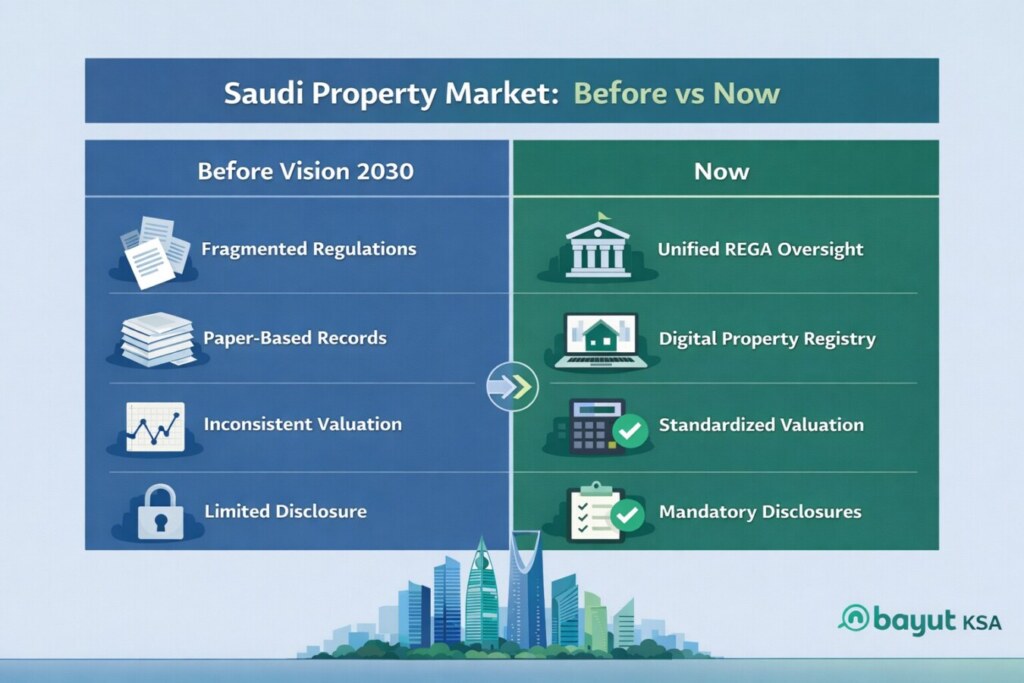
One of the biggest changes has been the rise of the Real Estate General Authority (REGA) as the central regulator. In the past, Saudi real estate regulations were applied unevenly, with different interpretations across cities.
Today, REGA provides a single framework that applies nationwide. In practice, this means:
- The same core rules apply across Riyadh, Jeddah, Makkah, Madinah, and new economic zones
- Brokers, developers, and valuers must hold valid licences to operate
- Official market data and price indices are released more consistently
This shift alone has removed a major source of uncertainty and made real estate transparency in Saudi Arabia easier to navigate.

Digital Registration: Making Ownership Verifiable
Another major step forward is the move to digital property registration. Instead of relying on scattered paperwork, Saudi Arabia now uses a central National Real Estate Registry.
The registry records:
- Ownership details
- Property rights
- Transaction history
- Valuation records
Because this system is now actively used in major cities, ownership can be verified faster and more reliably. Disputes, duplicate sales, and unclear titles are far easier to avoid. In simple terms, digital registration turns ownership into something you can check, not just assume.
Foreign Ownership Rules Are Becoming Clearer
Foreign ownership has long been an area of uncertainty. That is changing with the upcoming 2026 Foreign Ownership Law, one of the most important Saudi real estate market reforms in recent years.
The law introduces:

- Clear legal pathways for non-Saudis to own property in designated areas
- Defined ownership conditions in Makkah and Madinah for eligible Muslim residents
- Permission for foreign companies to buy commercial property for operations
- Mandatory digital registration of foreign-owned assets
Instead of navigating grey areas, foreign buyers will soon operate within a clearly defined legal framework, one that improves visibility and accountability across the market.
Why is Pricing Becoming More Reliable
In the past, property valuations could vary widely depending on who carried them out. Today, REGA requires:
- Licensed and certified valuers
- Standard valuation methods
- Transparent, documented reports
These changes improve price consistency and make comparisons more meaningful. As a result, Saudi property market transparency now extends beyond ownership into pricing itself.
Better Disclosure, Fewer Surprises
Transparency also depends on what buyers are told upfront. New rules now require developers to clearly disclose:
- Project timelines
- Escrow arrangements
- Construction progress
- Buyer rights
At the same time, authorities have tightened enforcement against misleading marketing and unlicensed activity. Together, these steps reduce information gaps and help people make decisions with fewer surprises.
Also, read about how to protect your real estate investment with Bayut-KSA.
Why Transparency Really Matters
Improving Saudi property market transparency is not just about compliance; it changes how the market functions. Clear ownership records, consistent pricing, and enforceable rules make it easier to understand risk, verify information, and move through transactions with confidence.
Saudi Arabia’s property market is steadily becoming more structured, data-driven, and aligned with international standards while still following its own regulatory path.
As transparency improves across the market, Bayut-KSA helps users navigate property options with clearer listings, structured information, and location-level context, supporting better comparisons in a market that is becoming easier to understand.