Investment decisions across Saudi Arabia reflect a growing focus on fundamentals. The factors influencing investment in Saudi Arabia now centre on demand, regulatory clarity, access to financing, and effective development. These conditions shape where capital concentrates and how long it stays. Investors who understand these factors make more consistent decisions than those who rely on market narratives alone.
Government Direction
Investors rarely react just to policy announcements. They react to whether those policies are executed consistently. In Saudi Arabia, long-term planning has begun to create a visible economic structure rather than distant targets.
What investors are responding to:
- Non-oil activities now contribute close to 50% of total GDP
- Government capital expenditure continues to prioritise housing, logistics, tourism, and infrastructure
- Over 85% of national transformation initiatives are completed or progressing as planned
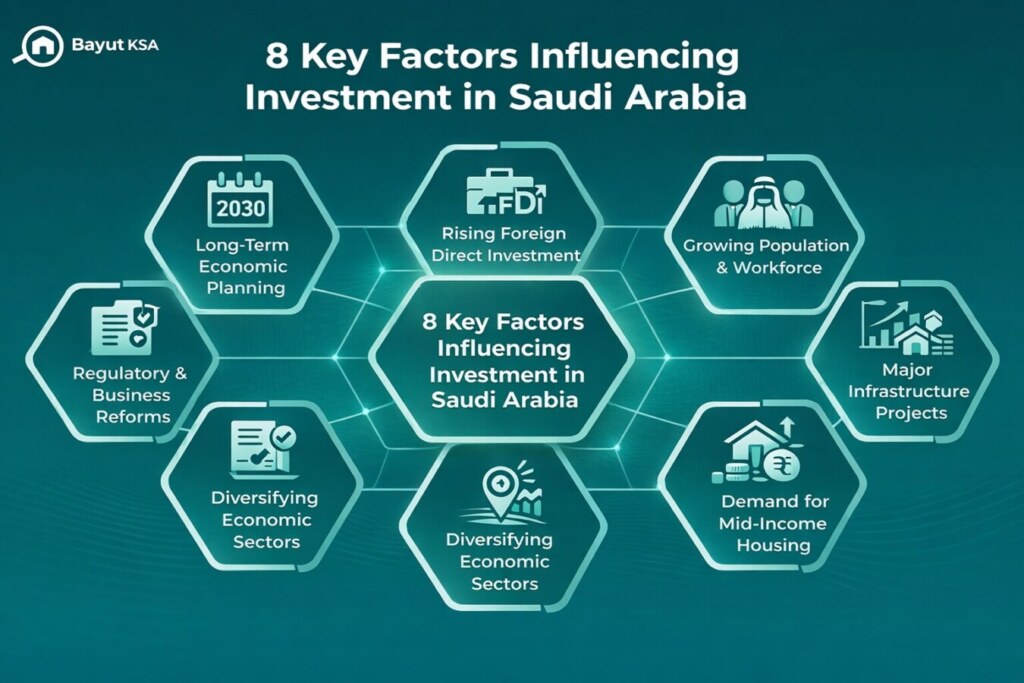
When economic direction is consistent and execution is visible, investors reduce risk premiums and extend holding periods. Capital prefers markets where planning translates into delivery.
Foreign Investment Momentum
Foreign investment does not arrive early. It arrives once systems work. The recent rise in cross-border capital reflects growing confidence in how the Saudi market operates, not short-term enthusiasm.
Recent investment signals include:
- Annual foreign direct investment inflows exceeding SAR 100 billion
- Year-on-year growth in cross-border investment activity
- Increased participation in real estate, logistics, manufacturing, and services
Where foreign investment concentrates:

- Major urban centres
- Operational or near-completion assets
- Sectors with clear exit visibility
Foreign capital amplifies competition for quality assets. It raises standards rather than lifting all valuations equally.
Workforce Dynamics
Population growth reshapes markets. In Saudi Arabia, where people live and work increasingly determines where capital performs.
Key demographic indicators:
- National population exceeding 35 million
- Ongoing urbanisation toward Riyadh, Jeddah, and the Eastern Province
- Rising workforce participation supporting consumption growth
Demand follows people. Assets aligned with population movement and employment clusters outperform those built ahead of demand.
Infrastructure as an Investment Signal
Infrastructure used to be a future story. Today, it is an immediate filter. Investors look at whether new systems reduce friction, shorten timelines, and change daily behaviour.
What has changed investor behaviour:
- Transport projects reducing commute times between residential and employment zones
- Digital planning systems cutting approval timelines by months rather than years
- Urban regeneration projects activating existing districts
What investors discount:

- Infrastructure tied to undeveloped areas without current demand
- Projects dependent on distant completion timelines
Infrastructure adds value when it reinforces existing activity, not when it attempts to manufacture.
Also, read about real estate investment in KSA.
Financing Conditions
Capital availability expands markets, but it also defines ceilings. In Saudi Arabia, financing has become a driver of participation rather than speculation.
Current financing realities:
- Mortgage penetration has expanded significantly over recent years
- Mid-income housing absorbs financing more efficiently than the luxury segments
- Affordability thresholds increasingly limit aggressive price growth
Leverage expands demand but caps upside. Sustainable investment now depends on income alignment rather than rapid appreciation.
Market Demand
Demand is measured through behaviour. Rental uptake, occupancy rates, and transaction volume now tell investors where value holds.
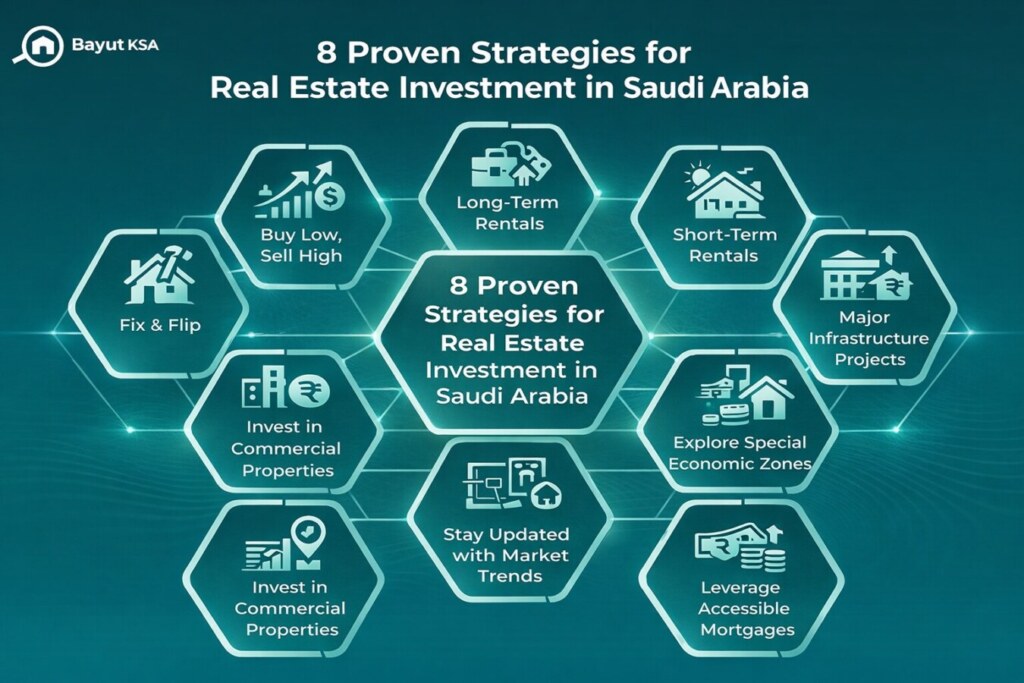
Observed market behaviour:
- Residential assets account for the majority of real estate transactions
- Mid-income housing absorbs supply faster than premium segments
- Rental demand remains strongest in employment-linked districts
Markets reward assets that serve everyday needs. Speculative positioning struggles once supply increases.
Sector Diversification
Investment in Saudi Arabia no longer funnels into a narrow set of industries. Capital now moves across sectors based on structural demand instead of historical dominance.
Areas attracting sustained capital:
- Residential and mixed-use real estate
- Logistics and industrial assets
- Tourism and entertainment
- Renewable energy and supporting infrastructure
Diversification reduces systemic risk and creates multiple entry points for different investor profiles.
From Insight to Action with Bayut-KSA
Understanding the factors influencing investment in Saudi Arabia is only valuable when those insights can be applied at a local level.
Bayut-KSA helps investors compare prices, demand, and verified listings across cities and neighbourhoods, making it easier to assess where opportunities align with real market behaviour.