Globally, real estate investors rely on two proven strategies to access property markets: owning assets directly or investing indirectly through funds and structured vehicles. In mature markets, these approaches coexist and complement each other. Direct and indirect real estate investment in Saudi Arabia is now following this global model, but with a distinct advantage.
The Kingdom is opening its real estate market at a time of strong economic momentum, regulatory reform, and large-scale urban development under Vision 2030. For both local and foreign capital, understanding how these two investment paths operate in Saudi Arabia has become central to making informed, long-term decisions.
Why Real Estate Matters in Saudi Arabia Right Now
Recent macroeconomic data underlines why real estate is no longer a peripheral sector in the Saudi economy:
- Total GDP (Q1 2025): SAR 1.02 trillion
- Real estate contribution to GDP (Q1 2025): SAR 74.4 billion
- Construction contribution to GDP (Q1 2025): SAR 92.0 billion
- Inflation (mid-2025): ~2.3%
These figures confirm that real estate and construction are core economic pillars, not speculative sidelines. This macro stability supports both direct ownership and indirect investment vehicles, creating multiple entry points for investors.
Direct Real Estate Investment in Saudi Arabia
Direct real estate investment in Saudi Arabia involves owning physical property, residential, commercial, hospitality, or industrial, either individually or through a registered entity.
Today, direct investment opportunities are expanding across:
- Residential developments in Riyadh and Jeddah
- Hospitality assets linked to tourism and pilgrimage
- Mixed-use urban districts
- Logistics and industrial assets supporting trade and manufacturing
Several recent developments have strengthened direct ownership:
- Digitised land registration and title verification
- Clearer zoning and valuation standards
- New foreign ownership pathways scheduled to take effect from 2026
Indirect Real Estate Investment in Saudi Arabia
Indirect real estate investment in Saudi Arabia allows investors to access the property market without owning physical assets. Instead, capital is deployed through regulated structures such as:
- Saudi-listed REITs
- Real estate investment funds
- Development-focused SPVs
- Listed companies with property-heavy portfolios
Indirect investment has gained traction as Saudi capital markets mature. These vehicles offer:

- Lower capital entry
- Diversification across assets and cities
- Professional management
- Easier liquidity compared to physical property
For many investors, especially institutions and first-time foreign entrants, indirect exposure provides a practical way to participate while monitoring regulatory and market evolution.
Key Differences: Ownership, Control, and Liquidity
A frequent question among international investors is what the difference is between foreign direct investment and indirect investment in real estate.
In Saudi Arabia:
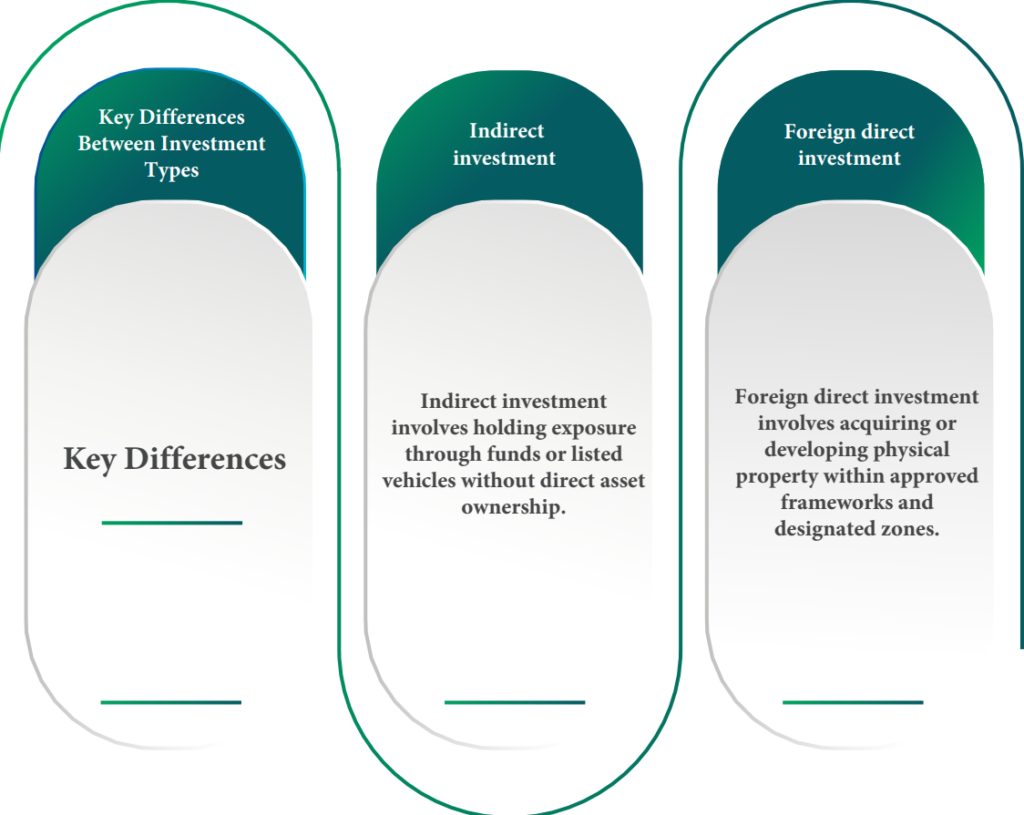
Direct investment offers control and asset specificity. Indirect investment offers diversification and flexibility. Increasingly, investors use both.
Also read how to get Saudi Premium Residency with Bayut-KSA.
Foreign Direct vs Indirect Investment
There is no single best option; outcomes depend on strategy and time horizon. That said, current trends point to strong performance in:
- Residential real estate, supported by population growth and urban expansion
- Hospitality assets, driven by tourism targets exceeding 100 million visitors annually
- Logistics and industrial real estate, aligned with diversification and manufacturing growth
- Mixed-use developments, combining residential, retail, and commercial demand
Many investors combine direct ownership in one segment with indirect exposure across others to balance risk and return.
Which Real Estate Segments Are Attracting Capital?
For international investors, real estate investment in Saudi Arabia for foreigners is becoming clearer and more structured.
- Residential: Driven by urban population growth, housing demand, and expatriate inflows.
- Hospitality & Tourism: Supported by Vision 2030 tourism targets and rising visitor numbers.
- Logistics & Industrial: Fuelled by manufacturing expansion, e-commerce, and trade diversification.
- Grade-A Offices & Mixed-Use: Boosted by corporate relocations and new business districts.
- REITs & Income Assets: Offering diversified, professionally managed exposure to stabilized properties.
The choice is not between direct and indirect investment, but how to combine them effectively. With informed planning and grounded market insight, including guidance from experienced market participants like Bayut-KSA, investors can engage Saudi Arabia’s real estate sector with confidence, clarity, and strategic intent.